Saturday, July 30, 2011
Queen of the Falls
Queen of the Falls
written and illustrated by Chris Van Allsburg, 2011. New York: Houghton Mifflin Books for Children. (9780547315812).
Author/ Illustrator Website: http://www.chrisvanallsburg.com/home.html
Media: pencil
Awards and Honors: none
Annotation:
As tall as a seventeen story building and unimaginably powerful, the Niagara Falls have long inspired awe in everyone who visits this natural wonder. This is the story of Annie Edson Taylor, the first person to go over Niagara Falls in a barrel.
Personal Reaction:
Chris Van Allsburg, well-known for his fantastical works of surrealistic fiction, tackles the story of Annie Edson Taylor the first person to ever go over Niagara Falls in a barrel. In 1901 Taylor was a 62 year old widow and retired charm school teacher, running low on money, when she decided that a trip over the falls might be just the thing to buoy her flagging finances. (Even though this is a true story, I was a bit perplexed as to how, after reading a newspaper article abut visitors to the falls, Taylor came to this conclusion.) Impressively enough, we learn that Taylor herself designed and commissioned a special barrel to be built that would be strong enough to withstand a trip over the falls and safe enough to protect her during the fall. She also had the forethought to hire a PR man who would drum up interest in her story and later manage her public appearances.
Taylor's trip over the falls was successful, of course, but her dreams of fame and fortune were not to be realized. She traveled the county fair circuits, making appearance and telling her story but the public wanted to see a real-life daredevil, not a "little old lady". Her manager steals her barrel, she gets it back, but gets a new manager who does the same, and she eventually has a new barrel made. She and her barrel end up in a park near the falls where she sells postcards of herself to passing tourists.
Taylor's story is pretty incredible. For a widowed woman of her age to attempt such a feat in 1901 is in itself quite amazing. But I had mixed feeling about the story: on one hand, this is an interesting argument for not judging a book by its cover, but Taylor's reasoning behind her stunt was just bizarre to me. Obviously financial gain was Taylor's primary concern, but how in the world she imagined such a dangerous stunt would be the answer to her problems was just plain weird. Its a shame that modern television reality shows weren't around in Annie Edson Taylor's time. If they were, she might just have realized her dreams.
Bones: Skeletons and How They Work
written and illustrated by Steve Jenkins, 2010, New York : Scholastic Press. (0545046513).
Author/Illustrator Website: http://www.stevejenkinsbooks.com/
Media: paper collage
Awards and Honors: A Junior Library Guild Selection for Fall 2010, A Society of Illustrators Original Art Show choice
Annotation: A creative look at bones and skeletons of all shapes and sizes, what they do, and how they do it.
Personal Reaction:
This is a wonderful picture book for children who are fascinated by bones or for educators to enrich lessons on the skeleton (human and otherwise). Steve Jenkins employs his trademark paper collage illustrations to explain how bones protect, support, and enable movement for all vertebrates. Cream collage skeletons on boldly colored solid pages are attention grabbers and Jenkins uses fold out double spreads to great effect in illustrating some spectacular full skeletons. One really neat feature of the illustations is that they are done to scale so that the reader can compare the sizes of various bones and animals. Jenkins includes additional facts, stories, history and science relating to bones at the end of the book. This is a book that elementary age kids (especially boys) will want to read again and again.
Curriculum Connection: Elementary school biology
Lesson Plan:
Subject Area:
Biology
Suggested Grade Level:
4-5
Lesson Title:
Bones
Time:
1-2 hours
Materials/Equipment Required:
- Bones: Skeletons and How They Work written and illustrated by Steve Jenkins
- modeling clay
- paper
- tape
- paper or plastic plates
- weights (wooden blocks)
Objectives:
Students will learn about bones (the different types, how they protect the body, support it and allow it to move) and joints in the human body.
Suggested Procedure:
Teacher will read aloud Bones: Skeletons and How They Work.
Bone and Joint Activity:
1) Teacher will show students a picture of a bone pointing out the
various parts of the bone, and reviewing important vocabulary.
2) Students will create a clay model of the bone, labeling the parts
of it.
3) Teacher will introduce the four joints of the human body.
4) The teacher will demonstrate the movements of the joints.
5) Students will brainstorm examples in the human skeletal system for each type of joint.
Bone Strength Activity:
1) Students will roll up half a sheet of letter-sized paper into a cylinder about 1 inch wide. They will make 3 of these.2) Students will stand the bones up on their ends and place a paper plate on top of the bones.
3) Students will begin to add weights (wooden blocks) to the plate.
4) Students will count how many blocks the plate can hold before the “bones" collapse.
5) Students will roll 3 more sheets of paper as tightly as they can so that there is no hollow section
6) Students will stand these "bones" up as before placing the same plate on top of them.
7) Students will place weights on top of the plate until they collapse.
8) Students will deduce what happened. Teacher will explain that hollow
bones were able to support more weight. Teacher will continue explaining that the large bones in our body are also hollow, which makes them strong so they can support more weight, but light, so it takes less energy to move them.
Labels:
2010/2011,
curriculum connection,
lesson plan
Benno and the Night of the Broken Glass
by Meg Wiviott, illustrated by Josee Bisaillon, 2010. Minneapolis, Minnesota: Kar-Ben Publishing. (978082259929).
Media: collage, drawings and digital editing
Author Website: http://megwiviott.com/
Illustrator Website: joseebisaillon.com
Awards and Honors: Selected as one of School Library Journal's Best Books 2010: Picture Books; Winner of Moonbeam Children's Book Awards' Gold Medal for Multi-cultural Picture Book; CCBC's 2011 Best Choice List
Annotation:
A picture book portrayal of Kristallnacht (The Night of Broken Glass) in Nazi Germany as seen through the eyes of Benno, the neighborhood cat.
Personal Reaction:
The human atrocities committed by Nazi Germany are a troubling and complex subject to teach to young children, but Benno and the Night of the Broken Glass is a sensitive and thoughtful introduction to the Holocaust. The violence is largely implied, and while it is jarring, it is not explicit or disturbing. By telling the story through the eyes of Benno, the neighborhood cat, readers are given a first-hand look at the destruction and persecution by an objective narrator. Because Benno is a neutral participant he describes the outward appearance of the events and doesn't delve into significance. However, by relating the devastion of Kristallnacht to one street in Berlin, Wiviott is able to personalize a disturbing historical event. An afterword gives the reader more details about Kristallnacht and a bibliography suggests sources for additional reading. This story lends itself to opening discussion about the persecution and murder of Jews during the Holocaust between parents or teachers and young children.
Curriculum Connection: Elementary school history- Holocaust
The Little Prince
The Little Prince
by Antoine de Saint-Exupery, illustrated by Joann Sfar, 2010. New York: Houghton Mifflin Harcourt. (0547338023)
Illustrator Website: http://www.joann-sfar.com/wpen/
Media: pen and ink, with color applied digitally
Awards and Honors: Angoulême International Comic Strip Festival, "Essential"- Youth category
Annotation:
A graphic novel adaptation of Antoine de Saint-Exupery's classic allegory, The Little Prince.
Personal Reaction:
The Little Prince- a story of an aviator crashlanded in the African desert who encounters a strange little boy from the heavens- has long been a classic of children's literature. I was given a copy of this book when I was eight years old and I've read and reread it many times throughout the years, gaining a different understanding and appreciation for it upon each reading. Having read the novel many times, though, I expected that the graphic adaptation wouldn't do the original justice, that somehow it would be a watered down shadow of de Saint-Exupery's allegory.
I was pleasantly surprised to find that Joann Sfar's graphic novel is not at all the bore that I expected, but actually manages to infuse the story with a deep sentiment and meaning. Where de Saint-Exupery's voice is at times detached, Sfar's adaptation is tender without being syrupy. The affection the pilot feels for the Little Prince is palpable, and the departure of the Little Prince at the end of the story is truly moving. While Sfar's illustrations may not be as charming as the originals, they likely open up the world of The Little Prince to a greater audience.
Labels:
2010/2011,
fiction in graphic novel format
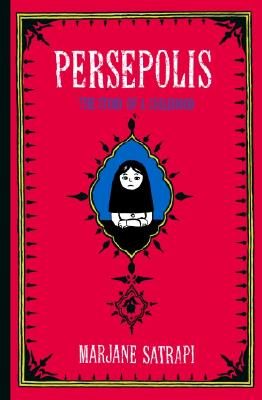
Persepolis: The Story of a Childhood
written and illustrated by Marjane Satrapi, 2003. New York : Pantheon Books. (0375422307).
Author/Illustrator Website: none
Media: pen and ink
Awards and Honors: 2004 ALA Alex Award, YALSA Best Books for Young Adults, Booklist Editor's Choice for Young Adults, New York Public Library Books for the Teen Age, School Library Journal Adult Books for Young Adults, A New York Times Notable Book, A Time Magazine “Best Comix of the Year”
Annotation:
A memoir of the author's childhood growing up in a politically radical and socially progressive family in Iran during the time of the Islamic Revolution.
Personal Reaction:
At turns scathingly political, disarmingly funny, and utterly heartbreaking, Persepolis is a powerful memoir of the author's childhood and coming of age in Iran during the 1970s and 80s. Marjane Satrapi blends the personal, the political and the historical to create an absolutely astonishing story that reminds us that sometimes truth really is more incredible than fiction.
From a young age Marji (as she is known by her family) is a bit of a rebel. She grows up as the only child in a family that is very progressive, both politically and socially- she reads Marxist comic books on dialectical materialism, believes herself to be the next prophet (so that she can bring social justice to society), and pretends to be Che Guevara when she plays revolutionaries with her friends. Marji is idealistic and passionate and her opinions are steadfast, until she begins to learn things that challenge her ideas of the world. Her family has a history of political radicalism- she learns that her grandfather had been a political prisoner who was eventually killed for his ideas, and eventually her uncle sees the same fate. When people begin to be murdered in demonstrations against the Shah in Tehran, Marji begins to understand that dogma, even if it is political, isn't all it's cracked up to be.
When the Shah is deposed, things get even worse. Even though the political movement had been a popular revolution, Islamic fundamentalists end up taking power, making things worse for Marji and her family. The fundamentalists impose strict religious law in Iran and Marji chafes under the new rules. War with Iraq brings very real danger to Tehran and eventually Marji's parents decide to send her out of the country rather than have her face the threat of bombings, imprisonment by secret police, or outright murder in the streets by the Shah's thugs.
Persepolis is an intense portrayal of the some of the extremes of the human experience- oppression, murder and war- but its real strength is that it never loses its human touch. Satrapi's story is unlike anything else I've ever read- it is nuanced, rich and ultimately very beautiful.
Wednesday, July 27, 2011
The Moon Over Star
The Moon Over Star
by Dianna Hutts Aston, illustrated by Jerry Pinkney, 2008, New York: Dial Books for Young Readers. (9780803731073).
Author Website: none
Illustrator Website: http://www.jerrypinkneystudio.com/
Media: graphite, ink and watercolor on paper
Awards and Honors: Coretta Scott King Honor, 2009
Annotation: In the rural south in 1969, a young girl is awed and inspired by the moon landing and dares to dream of what is possible.
Personal Reaction:
There's a lot going on in this small book. Dianna Hutts Aston addresses poverty, inequality, and the power of dreams while painting a beautiful portrait of the universal wonder and inspirational force that was the moon landing in 1969.
The story is told from the point of view of Mae, a young African American girl growing up in the rural south. She is completely awed by the moon landing and her family shares her enthusiasm- everyone except for Gramps who wonders aloud why people would "...spend all that money to go to the moon when there's so many folks in need right here on Earth?". Poverty and racism have restricted opportunities for his generation- from the time he was a young child he'd worked the farm, day in and day out, doing the same jobs. Mae dreams of one day going to the moon, and though her generation faces obstacles of poverty and racism, the reader is left hopeful that she will one day realize her aspirations.
Jerry Pinkney's illustrations, as always, are powerfully gorgeous. I especially liked the wonderfully textured paintings of the moon and earth from space and the double-page spread of the family sitting under the stars on that fateful night, faces turned upwards to the moon. Pinkney's special blend of realism and impressionism beautifully capture the mood of Aston's reflective and stirring story.
Sunday, July 24, 2011
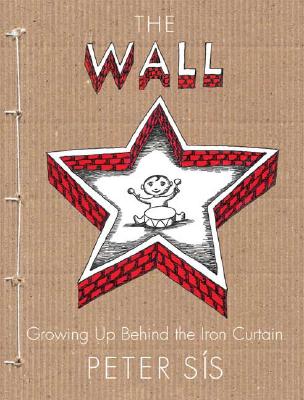
The Wall: Growing Up Behind the Iron Curtain
written and illustrated by Peter Sis, 2007, New York: Farrar, Straus and Giroux Books for Young Readers. (0374347018).
Author/Illustrator Website: http://www.petersis.com/
Media: pen and ink, with water color, colored pencils and multimedia elements
Awards and Honors: American Library Association Best Books for Young Adults; American Library Association Notable Children's Books; Caldecott Honor Book; IRA Notable Books for a Global Society; Boston Globe - Horn Book Award; New York Times Book Review Best Illustrated Books of the Year; Orbis Pictus; Amazon.com Top 10 Editors’ Picks: Children; Bank Street Best Children's Book of the Year; CCBC Choice (Univ. of WI); Children's Books: 100 Titles for Reading and Sharing, New York Public Library; Eisner Award Nominee; Parents' Choice Award Winner; NCSS-CBC Notable Trade Book in the Field of Social Studies; Booklinks Lasting Connection; Booklist Editors' Choice; Booklist Top 10 Biographies for Youth; Bulletin of the Center for Children’s Books Blue Ribbon Award; Horn Book Magazine Fanfare List; Kirkus Reviews Editor's Choice; Publishers Weekly Best Children's Books of the Year; School Library Journal Best Books of the Year; VOYA's Nonfiction Honor List; Robert F. Sibert Award - Medal; Capitol Choices Noteworthy Titles for Children and Teens; Illinois Read for a Lifetime Award Master List; Michigan Great Lakes Great Books Award Master List; New Mexico Battle of the Books Master List; North Dakota Flicker Tale Children's Award Master List; Utah Beehive Book Award Master List; Book Links; Booklist; Booklist, Starred; Top 10 Biographies for Youth; Boston Globe; Bulletin-Center Child Books, Starred; Horn Book, Starred Review; Kirkus Reviews, Starred Review; Los Angeles Times; New York Times Book Review; Publishers Weekly, Starred; San Francisco Chronicle; School Library Journal, Starred Review; USA Today; VOYA (Voice of Youth Advocates)
Annotation: Peter Sis' illustrated memoir of what life was like growing up behind the Iron Curtain.
Personal Reaction/ Discussion of Artwork:
Peter Sis was born in Czechoslovakia after World War II and grew up in Prague during the Cold War. This book is his attempt to explain to his children his life before he came to America. In The Wall, we hear his story, which is the story of many others who grew up under totalitarianism yet yearned to be free. An artist from a very young age, Sis felt the restrictions of Communist rule acutely. He tells of his childhood and adolescence- happy but never free of the ever-present influence of Communism. Russian language classes, public displays of loyalty and participation in the Communist youth movement are all compulsory activities for young Sis and his classmates. Initially he doesn't question the system, but as he gets older bits of Western news and media start to slip through the Iron Curtain. With this new information young people begin to question the old ways of doing things. In 1968, as Peter is entering young adulthood, Alexander Dubcek begins to ease the government's strict censorship policies and Peter's dream of freedom starts to seem possible. Art, travel, poetry, music, film and theater are burgeoning and Peter sees these methods of self-expression as ways to be free. Out of fear of losing control, the State soon cracks down on expression. Sis describes the fear and intimidation that ensues as dissidents are jailed, monitored, deported and tortured. Even under the intense oppression Peter continues to create and dares to dream of freedom. Peter leaves the Soviet Union in 1984 to go to the United States for work and doesn't return.
Through a combination of words, pictures, diary entries and scrap book style collages, Sis tells his story. Sis' cartoon-like drawings are deceptively simple. He uses multiple frames on most pages to show scenes of life in Soviet Prague. Color is symbolic in his illustrations. Scenes of life in the Soviet Union are rendered starkly in black and white pen drawings with brash dashes of red. Sis uses accents of full color to represent freedom. Peter's own drawings and other forms of self-expression, as well as all references to Western pop culture appear as bright, colorful spots in a sea of monochrome.
The Wall is a wondeful introduction to a complex and often confusing piece of history for children. Sis shares his personal experience in easily relatable language and images. Upper elementary students will gain from this book a better understanding of what life was like for children growing up in the Soviet Union.
Curriculum Connection: Upper Elementary or Middle School, Social Studies, Cold War
Lesson Plan:
Subject Area:
History
Suggested Grade Level:
6-8
Lesson Title:
Growing Up During the Cold War: Us vs. Them (adapted from http://www.the-best-childrens-books.org/The-Wall-Sis-ideas.html)
Time:
3-4 hours
Materials/Equipment Required:
-The Wall by Peter Sis
-timelines (http://www.the-best-childrens-books.org/The-Wall-timeline.html)
- pencils
Objectives:
Students will familiarize themselves with events in history during the Cold War and compare and contrast the contrasts of lifestyles for people on either side of the Iron Curtain.
Suggested Procedure:
1. Students will carefully read The Wall by Peter Sis.
2. Give the students the timelines and as a class brainstorm events that happened in the author’s life during the time and events that happened in the Soviet Union at that time
3. Students will then choose the 20 best for each category and on the top half of the paper (above the big black timeline bar), write:
- above the thin black top line--10 events that took place in the author's life at that time
- below the thin black top line--10 events that took place in the Soviet region at that time
4. Once the top part is done, for homework have the student interview someone they know (neighbor, grandparent...) who was born in the US in the 1940s or 1950s, asking him or her for memories of what they were doing during each era and memories of what was happening in the United State during that time. Encourage the student to ask questions of the interviewee to see if he or she felt the same way about living in the United States that the author did about living in the Soviet realm. (ie: "Did you feel free to listen to whatever music you wanted?", “Did you feel free to travel?”)
5. On the bottom half of the paper (below the big black timeline bar), write:
- above the thin black bottom line--10 events that took place in the United States at that time
- below the thin black bottom line--10 events that took place in the person's life at that time
6. As a class, share the work that each student did. Discuss similarities and differences among the results of the interviews (people growing up in the US) and similarities and differences between people growing up in the US and the Soviet Union.
Labels:
artwork,
curriculum connection,
lesson plan
Saturday, July 23, 2011
A River of Words: The Story of William Carlos Williams
by Jen Bryant, illustrated by Melissa Sweet, 2008. Grand Rapids, MI: Eerdmans Books for Young Readers. (9780802853028).
Author Website: http://www.jenbryant.com/
Illustrator Website: http://melissasweet.net/
Awards and Honors: About.com- Best Children's Books of 2008; Book Links- Lasting Connections of 2008; Caldecott Honor Book, 2009; Christian Science Monitor- Best Children's Books of 2008; CLN Chapter & Verse Book Club Selection; Cooperative Children's Book Center- Charlotte Zolotow Honor Award, 2009; Cybils Award Finalist, 2008; Junior Library Guild Selection; Kirkus Reviews- Best Children's Books of 2008; NCTE Notable Children's Books in the Language Arts, 2009; NCTE Orbis Pictus Award, 2009; New York Times Book Review- Best Illustrated Children's Books of 2008; Parents' Choice Award Recommended winner, 2008; School Library Journal Best Books, 2008.
Media: watercolor, collage and mixed media
Annotation: A visually stunning biography of physician and poet, William Carlos Williams.
Personal Reaction/ Discussion of Artwork:
When I was younger
it was plain to me
I must make something of myself.
- William Carlos Williams,
"Pastoral"
Jen Bryant begins her picture biography of the poet, William Carlos Williams, with this quote taken from his own verse. While enamored with words, Williams felt obligated to "make something" of himself and followed his duty to seek a profession. Though Williams is perhaps best known for his contributions to modern American poetry, he was also a doctor who delivered an estimated 3,000 babies during his career. Bryant tells the story of how William Carlos Williams served the community as a doctor, while still pursuing his passion for poetry.
Bryant focuses on Williams' childhood, his love for nature and its rhythms, and his love of poetry and art. Bryant's prose is simple and lyrical, echoing Williams' own verse. Often her words even look like the lines of a poem:
"I have never seen a swan or an archer," Willie thought.
"I want to write about ordinary things-
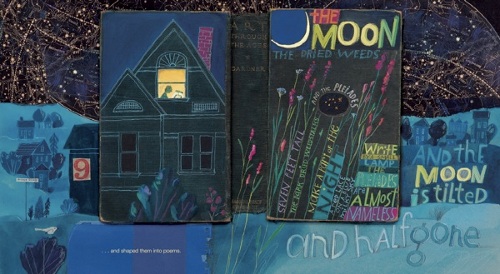
plums, wheelbarrows, and weeds,This is also a visually beautifully book. Melissa Sweet's brightly colored, richly textured and layered collages provide a depth to this book that invites multiple re-readings. Upon examining the illustrations, we see Sweet has incorporated stationery, notebooks and even pages of medical books into her collages. Additionally, Sweet adds even more depth by working in to her collages Williams' own poems. In the spread pictured above, Sweet has turned Williams' poem "The Descent of Winter" into a gorgeous nighttime scene. We can see Williams' silhouette in the upstairs window of his home. The lines of the poem are spread out over the pages and Sweet has beautifully depicted the images of the poem: the moon, the dried weeds and the Pleiades. The collaged book covers and starcharts combined with Sweet's color palette of rich blues creates a lovely, evocative effect.
fire engines, children, and trees-
things I see when I walk down my street
or look out my window."
Curriculum Connection: 6th grade- Language Arts/poetry
Labels:
artwork,
biography,
Caldecott Honor,
curriculum connection,
poetry
Girl Stories
Girl Stories
written and illustrated by Lauren R. Weinstein, 2006. New York: Henry Holt and Company. (0805078630).
Author/Illustrator Website: http://www.girlstoriescomics.com/home.html
Media: pen and ink with digital color
Awards and Honors: Books for the Teen Age, New York Public Library; CCBC Choice (Univ. of WI)
Annotation: A collection of short semi-autobiographical comics about the awkwardness (and occasional hilarity) of the adolescence experience.
Personal Reaction:
I read Girl Stories immediately after reading Craig Thompson's acclaimed graphic novel, Blankets and I can't help but compare the two. While I appreciated the "heart on its sleeve" sincerity of Blankets, the extreme sentimentality of Thompson's memoir was overbearing at times. Girl Stories relates the experience of growing up as an outsider with tongue-in-cheek, dark humor. To be sure, Girl Stories is not the arching 600-page bildungsroman that is Blankets. While Thompson writes from a place not too far removed emotionally from the events depicted in his story, Weinstein uses the perspective gained from time to weave ridiculously entertaining tales of experiences that probably weren't at all funny at the time. From embarassing parents, to awkward school dances and first dates, Girl Stories relates the mortifying experiences of adolescence with a wittiness that's hard to dislike- I found myself laughing out loud at many of the vignettes.
Labels:
fiction in graphic novel format,
humor
Monday, July 18, 2011
Tyranny
Tyranny
written and illustrated by Lesley Fairfield. 2009. Plattsburgh, New York: Tundra Books. (0887769039)
Media: pen and ink
Awards and Honors: 2010 Finalist, Governor General's Literary Awards, Children's Literature - Text
Annotation: A stark tale of a teenager's struggle with and ultimate triumph over anorexia and bulimia.
Personal Reaction/Potential Challenge and Response:
Tyranny is Lesley Fairfield's semi-autobiographical graphic novel about her struggle with anorexia and bulimia. These two diseases are all too common among young girls in America, particularly those in middle and high schools. This book offers a realistic look at the horror of eating disorders and an encouraging account of one girl's triumph over her demons.
Anna's a normal high schooler who frets about her appearance and wants to look like the fashion models she admires. Her concern over her weight starts out innocently enough, but quickly spirals out of control. Pretty soon she's hardly eating and weighing herself several times a day, terrified of putting on one pound. Things go from bad to worse when Anna moves out of her parents' house and Tyranny appears. Tyranny is anorexia, personified- the voice in Anna's head telling her she's fat, telling her not to eat, telling her she is worthless. Tyranny is depicted as a manic, skeletal figure who, from that point on, is ever-present in Anna's life. She teaches Anna how to take binge and purge and use laxatives to lose weight.
Eventually, Anna's body starts giving out on her and after she collapses in the street she enters an eating disorder treatment facility. It is here that she begins working through her problems and fighting back against Tyranny. Her treatment teaches her about herself and her disease, and seeing others go through what she did opens her eyes. Slowly but surely she starts to take pleasure in life and look forward to her future. In the last pages, Anna banishes Tyranny (who dissolves into a puddle of rippled lines) once and for all.
This is an important and realistic look at the deadly disorders of anorexia and bulimia. Though some parents may take issue with its graphic depictions of eating disorders or worry that the story may actually encourage teens to develop these behaviors themselves, it's a book that needs to be read, and discussed, among teens. Fairfield certainly doesn't pull punches, but teens are capable of understanding and learning from Anna's harrowing experiences. In addition to portraying the dangers of eating disorders, Tyranny also addresses the media's role in influencing girls' standards of beauty- an important and eye-opening lesson for teens. Early on in the book Anna's teacher shows how photographs of models are digitally altered so that they are impossibly proportioned. She cautions students to, "use an analytical eye when you look at a fashion magazine photo, and remember, the most beautiful you is you". However well-intentioned the urge may be for parents, its dangerous to restrict young people's access to books that deal with serious issues. The inclusion of this book and other titles like it in school and public libraries is crucial so that teens have access to materials that deal realistically with issues that they may face (however grim they are). Inclusion of a book within a library collection doesn't imply endorsement of an author's viewpoint or experiences; it gives a community access to the many different ideas and individual experiences within our culture.
Subscribe to:
Posts (Atom)