Showing posts with label Caldecott Honor. Show all posts

Sunday, May 13, 2012

No, David!


No, David!. written and illustrated by David Shannon. 1998. 32p. New York: Scholastic Press.


Medium: oil

Awards and Honors: Caldecott Honor, New York Times Best Illustrated Book, SLJ Best Book

Audience: 2 and up

Annotation:  
A gleefully naughty preschooler finds all sorts of ways to get himself in trouble, much to the chagrin of his exasperated mother.

Personal Reaction

Snaggle-toothed, lumpy headed David is the ultimate mischief-maker. He bangs pots and pans, plays with his food, tracks dirt in the house and even runs down the street sans clothes, while his exasperated mother vainly attempts to rein him. When finally David breaks his mother's vase he is repentant, and runs into the unconditionally loving arms of his mother, who reassures him, "Yes, David... I love you!". 


No, David! is an exuberant romp of a book. Filled with visual jokes accompanied by the refrain, "No, David!", this book imagines all of the ways a naughty little boy could manage to make trouble. Each page will be met with roars of laughter from young children and nods from knowing parents.

Saturday, May 12, 2012

Kitten's First Full Moon


Kitten's First Full Moon. written and illustrated by Kevin Henkes. 2004. 40p. New York: Greenwillow Books. 

Author/Illustrator Website: www.kevinhenkes.com

Medium: colored pencil and gouache

Awards and Honors: Caldecott Medal

Audience: 2 and up

Annotation:
When Kitten sees the full moon for the first time, she thinks that it's a bowl of milk and she tries to catch it. 

Personal Reaction
When plucky little Kitten sees the full moon for the first time, she thinks that it's a bowl of milk and she tries to catch it. She jumps from the top step of the porch, but she only succeeds in falling down. She tries to chase it down, but it never gets any closer. But Kitten is very persistent. She climbs up to the top of a tree to try to get nearer to the moon and she jumps into the pond to try to catch the reflection, but none of these things work! Finally, she goes back home to find that her owner has left a great big bowl of milk on the porch for her. 

In Kitten's First Full Moon Henkes puts a different spin on his distinctive style of illustration by working entirely in shades of black and grey. It makes sense for the subject matter- a moonlit night- and also helps temper the inherent cuteness of Kitten. The book works well as a read-aloud- kids will enjoy joining in the refrain "poor kitten!".

Friday, May 11, 2012

Interrupting Chicken


Interrupting Chicken. written and illustrated by David Ezra Stein. 2010. 32p. Somerville, MA: Candlewick Press. 

Author/Illustrator Website: www.davidezra.com

Medium: watercolor, water soluble crayon, china marker, pen, opaque white ink and tea

Awards and Honors: Caldecott Honor

Audience: ages 4 and up

Annotation: Little Chicken wants a bedtime story but every time her Papa starts to read Chicken can't help but interrupt.


Personal Reaction: 
Children's librarians love this book. And with good reason- it's clever, it's cute, and it references classic children's stories. 


Little Chicken wants Papa to read her a bedtime story, but she can't help but interrupting the books each time he starts. When Papa is reading Hansel and Gretel and the siblings are about to enter the witch's house, Little Chicken screams out, "Don't go in! She's a witch!", effectively ending the story right then and there. When Papa tries to read Little Red Riding Hood and the wolf appears, Little Chicken screams out, "Don't talk to strangers!". And so on, until Papa suggests that Little Chicken tells him a bedtime story. Just as Little Chicken begins to tell her story, she is interrupted by a loud snore- Papa has fallen fast asleep and Little Chicken climbs into bed alongside him and goes to sleep. 


Little Chicken's irrepressible concern is adorable- it's obvious she's heard all of these stories many time over, yet she just can't help but jumping in to "save" the characters. The book's 'story within a story' structure is clever and satisfying. Children who are familiar with the original stories will get the most out of this book, though it's enjoyable enough to share with those who haven't heard them.

Friday, May 4, 2012

A Ball for Daisy


A Ball for Daisy. written and illustrated by Chris Raschka. 2011. 32p. New York: Schwartz & Wade. 

Author/Illustrator Website: none

Medium: ink, watercolor and gouache
 
Awards and Honors: Caldecott Medal, 2012, A New York Times Best Illustrated Children's Book of the Year, A School Library Journal Best Book of the Year, A Horn Book Fanfare Title

Audience: 2 and up

Annotation:
A tale of love, loss and forgiveness, all as seen through the eyes of a dog.

Personal Reaction:
A Ball for Daisy is the latest Caldecott Medal winner from acclaimed author/illustrator, Chris Raschka (his Hello, Goodbye Window also won the Caldecott Medal in 2006). Raschka spins a tale of love, loss and forgiveness, as seen through the eyes of a dog, in his newest story. Daisy adores her red ball- she chases it, plays with it, and even cuddles up with it when she sleeps. When her beloved ball is accidentally popped by another dog, Daisy is devastated until the next day when the dog and its owner surprise Daisy with a special gift.

Raschka's illustrations- all flowing black lines, washes of soft pastel and pops of brilliant color- are stunners. They're fluid and loose, almost to the point of abstraction, yet remain expressive. This refined technique is paired with comic-style panel sequences to striking effect. Raschka keeps the action dynamic with variation in perspective and frames- full-page panels are mixed with multi-panel sequences and full bleed double-page spreads. The illustrations demonstrate a sophisticated artistry and eye for design rarely seen in children's books. 

I'm a sucker for well-executed wordless picture books and A Ball for Daisy hits all the right notes. Compelling storyline? Check. Engaging characters? Check. Brilliant illustrations? Check.


Friday, August 5, 2011

Dave the Potter: Artist, Poet, Slave


Dave the Potter: Artist, Poet, Slave
by Laban Carrick Hill, illustrated by Bryan Collier. 2010. New York: Litte, Brown and Company. (9780316107310).

Media: watercolor and collage on 400lb Arches watercolor paper

Author Website: http://www.labanhill.com/

Illustrator Website: http://bryancollier.com/

Awards and Honors: New York Times Bestseller; 2011 Caldecott Honor; 2011 Coretta Scott King Gold Award for Illustrations; Chicago Public Library's 2010 Best of the Best List; New York Public Library's 2010 Best 100 Books of the Year; Notable Social Studies Trade Books for Young People, 2011

Annotation:
At once personal and historical, this is the extraordinary story of Dave, a poet, potter and slave living in South Carolina during the 19th century.

Personal Reaction:
     Dave the Potter is the extraordinary story of Dave, a poet, potter and slave living in South Carolina during the 19th century. Laban Hill's simple yet noble prose and Bryan Collier's rich collage illustrations come together in this book to tell the story of one man who, despite having all freedom stolen from him, created lasting beauty and, we can imagine, a sense of dignity in his life. Dave's pots were meant to be functional pieces, but their beauty is plain to be seen. What's most incredible about his work is that on many of his pots, he inscribed short poems. In a time when reading and writing was forbidden to slaves, this was really something exceptional. This book really speaks to the innate human urge to create art and poetry that we hope will outlast our own temporal lives.

Saturday, July 23, 2011

A River of Words: The Story of William Carlos Williams


A River of Words: The Story of William Carlos Williams
by Jen Bryant, illustrated by Melissa Sweet, 2008. Grand Rapids, MI: Eerdmans Books for Young Readers. (9780802853028).

Author Website: http://www.jenbryant.com/

Illustrator Website: http://melissasweet.net/

Awards and Honors: About.com- Best Children's Books of 2008; Book Links- Lasting Connections of 2008; Caldecott Honor Book, 2009; Christian Science Monitor- Best Children's Books of 2008; CLN Chapter & Verse Book Club Selection; Cooperative Children's Book Center- Charlotte Zolotow Honor Award, 2009; Cybils Award Finalist, 2008; Junior Library Guild Selection; Kirkus Reviews- Best Children's Books of 2008; NCTE Notable Children's Books in the Language Arts, 2009; NCTE Orbis Pictus Award, 2009; New York Times Book Review- Best Illustrated Children's Books of 2008; Parents' Choice Award Recommended winner, 2008; School Library Journal Best Books, 2008.

Media: watercolor, collage and mixed media

Annotation: A visually stunning biography of physician and poet, William Carlos Williams.

Personal Reaction/ Discussion of Artwork:

When I was younger
it was plain to me
I must make something of myself.
            - William Carlos Williams,
              "Pastoral"

     Jen Bryant begins her picture biography of the poet, William Carlos Williams, with this quote taken from his own verse. While enamored with words, Williams felt obligated to "make something" of himself and followed his duty to seek a profession. Though Williams is perhaps best known for his contributions to modern American poetry, he was also a doctor who delivered an estimated 3,000 babies during his career. Bryant tells the story of how William Carlos Williams served the community as a doctor, while still pursuing his passion for poetry.  

     Bryant focuses on Williams' childhood, his love for nature and its rhythms, and his love of poetry and art. Bryant's prose is simple and lyrical, echoing Williams' own verse. Often her words even look like the lines of a poem:
"I have never seen a swan or an archer," Willie thought.
"I want to write about ordinary things-
plums, wheelbarrows, and weeds, 
fire engines, children, and trees- 
things I see when I walk down my street
or look out my window."
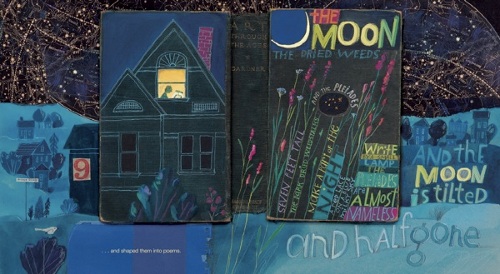
     This is also a visually beautifully book. Melissa Sweet's brightly colored, richly textured and layered collages provide a depth to this book that invites multiple re-readings. Upon examining the illustrations, we see Sweet has incorporated stationery, notebooks and even pages of medical books into her collages. Additionally, Sweet adds even more depth by working in to her collages Williams' own poems. In the spread pictured above, Sweet has turned Williams' poem "The Descent of Winter" into a gorgeous nighttime scene. We can see Williams' silhouette in the upstairs window of his home. The lines of the poem are spread out over the pages and Sweet has beautifully depicted the images of the poem: the moon, the dried weeds and the Pleiades. The collaged book covers and starcharts combined with Sweet's color palette of rich blues creates a lovely, evocative effect.

     All in all, Bryant and Sweet have created a wonderful book with A River of Words- simple and charming enough to be enjoyed by a young child, yet with a beauty and depth that will captivate adults as well.

Curriculum Connection: 6th grade- Language Arts/poetry

Monday, July 18, 2011

Harlem


Harlem
a poem by Walter Dean Myers, illustrated by Christopher Myers. New York: Scholastic. 1997. (0590543407).

Author Website: http://www.walterdeanmyers.net/

Illustrator Website: none

Media: ink, gouache and collage

Awards and Honors: Caldecott Honor Book, 1998; Coretta Scott King Award; Selected title of the White Ravens, 1998; Boston Globe-Horn Book Award, Fiction Honor, 1997

Annotation:
A boldly illustrated, vibrant and sophisticated tale of the storied New York neighborhood and the people who moved there for the promise of a better life. 

Personal Response: 
     "Harlem was a promise..." begins Walter Dean Myers' poetic tribute to the community, culture and contributions of Harlem and its people. A hope for a better life drew people to the neighborhood where they created a vibrant new community. Myers has written much about Harlem in his novels for young adults, and he manages to encapsulate the spirit and soul of the neighborhood in this poem. Myers' rhythmic prose, its cadence reminiscent of a preacher's sermon, vividly conveys the sights, sounds, smells and colors of Harlem. Christopher Myers' collage illustrations, rendered in bold warm tones accented with strong indigos focus primarily on the residents, both young and old, engaged in play, worship and social activities. This is a beautiful and lyrical book, which will likely appeal to an older audience. Those older readers already familiar with landmarks like the Apollo and the Cotton Club and figures such as Langston Hughes and W.E.B. Du Bois will get the most out of this poem- its references are too sophisticated for elementary or even most middle school readers.