Showing posts with label biography. Show all posts

Monday, August 13, 2012

The Tree of Life: Charles Darwin


The Tree of Life: Charles Darwin. Peter Sis. (2003). 44p. New York: Farrar,  Straus & Giroux.

Awards and Honors: 
American Library Association Best Books for Young Adults, American Library Association Notable Children's Books, New York Times Book Review Best Illustrated Books of the Year, New York Times Book Review Notable Children's Books of the Year, Amazon.com Top 10 Editors’ Picks: Children, Bank Street Best Children's Book of the Year, Parents' Choice Award Winner, John Burroughs List of Nature Books for Young, National Science Teacher's Association-CBC, Outstanding Science Trade Books for Children, Horn Book Magazine Fanfare List, Kirkus Reviews Editor's Choice, Publishers Weekly Best Children's Books of the Year, School Library Journal Best Books of the Year

Review:
A wondrous and detailed look into the life and work of famed naturalist and father of the theory of natural selection, Charles Darwin. In inimitable Sis style, this book takes on an almost scrapbook-like quality, featuring highly detailed illustrations, panels within panels, diary pages, maps, and a double gate-fold panel, while it illuminates Darwin's personal and professional life. Sis does an excellent job of balancing his own dreamlike aesthetic with the facts and figures of Darwin's life, while managing to steer clear of inflaming the religious controversies surrounding Darwin's work.

Opinion:
This is a spectacular picture book for older readers, packed with incredible detail and fact.

Ideas:
Picture books for older readers really deserve more attention. I'd feature this book in a library display spotlighting great illustrated books for older readers.

Monday, August 1, 2011

Black Jack: The Ballad of Jack Johnson


Black Jack: The Ballad of Jack Johnson
by Charles R. Smith, illustrated by Shane W. Evans, 2010, New York: Roaring Brook Press. (9781596434738).


Illustrator Website: http://www.shaneevans.com/

Media: pen and ink, oil paint and collage

Awards and Honors: IRA Notable Books for a Global Society; Chicago Public Library Best of the Best; Booklist, Starred Review; Publishers Weekly, Starred Review; School Library Journal, Starred Review

Annotation:
A biography, in rhyming verse, of Arthur John "Jack" Johnson, the world's first black heavyweight champion.

Personal Reaction:
     With rhyming verse and bold illustrations Charles R. Smith and Shane W. Evans tell the story of Jack Johnson, the world's first black heavyweight champion. A "brave, strong, fightin' man", Jack was determined to become a "great man"- a dream he accomplished when he defeated Jim Jeffries on the Fourth of July in 1910. Smith does a masterful job at writing Johnson's story- he's able to balance historical detail with really entralling storytelling. A non-fiction book told in rhyming verse and shining with personality is a rarity. Evans' illustrations, rendered in big blocks or deep color, are bold and dynamic. He includes historic newspaper clippings and photos of Johnson as subtle collage details that lend to the story. Black Jack: The Ballad of Jack Johnson is a great example of a how a non-fiction story can be told creatively and compellingly.

Saturday, July 30, 2011

Queen of the Falls


Queen of the Falls
written and illustrated by Chris Van Allsburg, 2011. New York: Houghton Mifflin Books for Children. (9780547315812).

Author/ Illustrator Website: http://www.chrisvanallsburg.com/home.html

Media: pencil

Awards and Honors: none

Annotation:  
As tall as a seventeen story building and unimaginably powerful, the Niagara Falls have long inspired awe in everyone who visits this natural wonder. This is the story of Annie Edson Taylor, the first person to go over Niagara Falls in a barrel.

Personal Reaction:
      Chris Van Allsburg, well-known for his fantastical works of surrealistic fiction, tackles the story of Annie Edson Taylor the first person to ever go over Niagara Falls in a barrel. In 1901 Taylor was a 62 year old widow and retired charm school teacher, running low on money, when she decided that a trip over the falls might be just the thing to buoy her flagging finances. (Even though this is a true story, I was a bit perplexed as to how, after reading a newspaper article abut visitors to the falls, Taylor came to this conclusion.) Impressively enough, we learn that Taylor herself designed and commissioned a special barrel to be built that would be strong enough to withstand a trip over the falls and safe enough to protect her during the fall. She also had the forethought to hire a PR man who would drum up interest in her story and later manage her public appearances. 
   
     Taylor's trip over the falls was successful, of course, but her dreams of fame and fortune were not to be realized. She traveled the county fair circuits, making appearance and telling her story but the public wanted to see a real-life daredevil, not a "little old lady". Her manager steals her barrel, she gets it back, but gets a new manager who does the same, and she eventually has a new barrel made. She and her barrel end up in a park near the falls where she sells postcards of herself to passing tourists. 

     Taylor's story is pretty incredible. For a widowed woman of her age to attempt such a feat in 1901 is in itself quite amazing. But I had mixed feeling about the story: on one hand, this is an interesting argument for not judging a book by its cover, but Taylor's reasoning behind her stunt was just bizarre to me. Obviously financial gain was Taylor's primary concern, but how in the world she imagined such a dangerous stunt would be the answer to her problems was just plain weird. Its a shame that modern television reality shows weren't around in Annie Edson Taylor's time. If they were, she might just have realized her dreams.

Saturday, July 23, 2011

A River of Words: The Story of William Carlos Williams


A River of Words: The Story of William Carlos Williams
by Jen Bryant, illustrated by Melissa Sweet, 2008. Grand Rapids, MI: Eerdmans Books for Young Readers. (9780802853028).

Author Website: http://www.jenbryant.com/

Illustrator Website: http://melissasweet.net/

Awards and Honors: About.com- Best Children's Books of 2008; Book Links- Lasting Connections of 2008; Caldecott Honor Book, 2009; Christian Science Monitor- Best Children's Books of 2008; CLN Chapter & Verse Book Club Selection; Cooperative Children's Book Center- Charlotte Zolotow Honor Award, 2009; Cybils Award Finalist, 2008; Junior Library Guild Selection; Kirkus Reviews- Best Children's Books of 2008; NCTE Notable Children's Books in the Language Arts, 2009; NCTE Orbis Pictus Award, 2009; New York Times Book Review- Best Illustrated Children's Books of 2008; Parents' Choice Award Recommended winner, 2008; School Library Journal Best Books, 2008.

Media: watercolor, collage and mixed media

Annotation: A visually stunning biography of physician and poet, William Carlos Williams.

Personal Reaction/ Discussion of Artwork:

When I was younger
it was plain to me
I must make something of myself.
            - William Carlos Williams,
              "Pastoral"

     Jen Bryant begins her picture biography of the poet, William Carlos Williams, with this quote taken from his own verse. While enamored with words, Williams felt obligated to "make something" of himself and followed his duty to seek a profession. Though Williams is perhaps best known for his contributions to modern American poetry, he was also a doctor who delivered an estimated 3,000 babies during his career. Bryant tells the story of how William Carlos Williams served the community as a doctor, while still pursuing his passion for poetry.  

     Bryant focuses on Williams' childhood, his love for nature and its rhythms, and his love of poetry and art. Bryant's prose is simple and lyrical, echoing Williams' own verse. Often her words even look like the lines of a poem:
"I have never seen a swan or an archer," Willie thought.
"I want to write about ordinary things-
plums, wheelbarrows, and weeds, 
fire engines, children, and trees- 
things I see when I walk down my street
or look out my window."
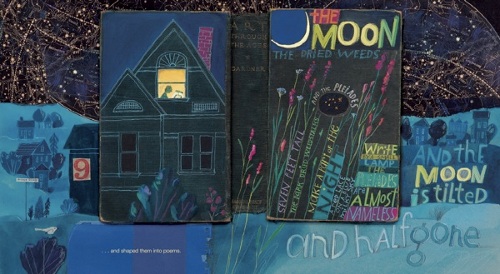
     This is also a visually beautifully book. Melissa Sweet's brightly colored, richly textured and layered collages provide a depth to this book that invites multiple re-readings. Upon examining the illustrations, we see Sweet has incorporated stationery, notebooks and even pages of medical books into her collages. Additionally, Sweet adds even more depth by working in to her collages Williams' own poems. In the spread pictured above, Sweet has turned Williams' poem "The Descent of Winter" into a gorgeous nighttime scene. We can see Williams' silhouette in the upstairs window of his home. The lines of the poem are spread out over the pages and Sweet has beautifully depicted the images of the poem: the moon, the dried weeds and the Pleiades. The collaged book covers and starcharts combined with Sweet's color palette of rich blues creates a lovely, evocative effect.

     All in all, Bryant and Sweet have created a wonderful book with A River of Words- simple and charming enough to be enjoyed by a young child, yet with a beauty and depth that will captivate adults as well.

Curriculum Connection: 6th grade- Language Arts/poetry

Thursday, July 14, 2011

Blockhead: The Life of Fibonacci


Blockhead: The Life of Fibonacci
by Joseph D'Agnese, illustrated by John O'Brien, 2010. New York: Henry Holt and Company. (9780805063059).

Media: pen and watercolor

Author Website: http://www.josephdagnese.com/Welcome.html

Illustrator Website: none

Awards and Honors: Best 2010 Science Books for Kids — Smithsonian Magazine, Best Children’s Books of the Year — Bank Street College, Noteworthy Books for Children and Teens — Capitol Choices, 2011 ALSC Notable Nominee, Best Books for 2010 — Children’s Book Compass

Annotation:
     Leonardo Fibonacci is considered one of the greatest Western
mathematicians, but it wasn't always this way. When he was a kid he
daydreamed about numbers so much that people called him "Blockhead", until he learned that there's nothing stupid about following your passion.

Personal Reaction:
      Leonardo loves numbers and he thinks about them day and night. He daydreams about numbers so much that people begin calling him "Blockhead". Leonardo tries to ignore them and follows the advice of a friend who tells him, "... learn all you can about numbers. That way you will always be happy". This is a story not only about the mathematician known as Leonardo Fibonacci, but also about following your passion regardless of what other people think

     Even though Fibonacci lived almost 900 years ago, Joseph D'Agnese's first-person narrative style makes the story accessible for children and relatable enough that it seems as if it could have happened yesterday. D'Agnese takes what little is known about Fibonacci's life and skillfully pieces it together with a bit of imagination to fortify the tale. It's a kid friendly story filled with dashes of humor- when Leonardo's portly friend encourages him to follow his dreams, he says matter-of-factly, "I think people are happiest when the know what pleases them. Me, I love cheese". In another scene, Leonardo visits the palace of the Holy Roman Emperor who challenges him to solve "a bunch of really hard math problems". When Leonardo quickly completes the problems the Emperor calls Leonardo "one smart cookie". O'Brien's cheerful illustrations are filled with nautilus shells, sunflowers and ferns- all references to Fibonacci's famous pattern.

     Even if you are unfamiliar with Fibonacci and his famous numbers, Blockhead is well-crafted enough to enjoy simply on its own merits. This books would make an excellent addition to an upper elementary school classroom or library.

Curriculum Connection: 5th grade, math.

Tuesday, July 12, 2011

Ben and the Emancipation Proclamation


Ben and the Emancipation Proclamation
by Pat Sherman, illustrated by Floyd Cooper, 2010. Grand Rapids, Michigan: Eerdmans Books for Young Readers. (9780802853196).

Author Website: none

Illustrator Website: http://www.floydcooper.com/

Media: oil wash on board

Awards and Honors: none

Annotation: The true story of Ben, a young slave who teaches himself to read in a time when literacy was forbidden for African Americans. His ability to read proves important to others when President Lincoln issues the Emancipation Proclamation.

Personal Reaction: Author Pat Sherman and Coretta Scott King Award winning illustrator, Floyd Cooper tell the touching true story of Benjamin Holmes, a young slave living during the Civil War who teaches himself to read. Ben's father teaches him the alphabet before he is sold and when Ben is apprenticed to a tailor in Charleston he practices reading while running errands for his boss. Ben reads street signs, shopping lists and even bits of discarded newspaper.

    Ben knows to hide the fact that he can read and write- it's dangerous for a slave to be educated and he has to be very careful. But he is not able to hide his reading and writing from the other slaves for long. Word gets around and wherever Ben's errands take him slaves implore Ben to teach them to read and write. Before long the Union Army pushes closer towards Charleston and Ben's employer flees, leaving Ben in a slave prison. Weeks pass while Ben and his fellow prisoners are cut off from any news of the War. One night the prisoners bribe a guard to get the latest copy of the Charleston Mercury and ask Ben to read the message from Abraham Lincoln that is printed inside- the Emancipation Proclamation. The author's note tells readers that Ben did not immediately gain his freedom but ended up working in several businesses. He eventually enrolled in Nashville's Fisk University, traveled internationally with Fisk's chorus and taught in a rural school before dying of tuberculosis sometime during the 1870s.

   The story is a testament to the power of the written word and the liberating force of education. Pat Sherman has done a wonderful job of telling Ben's story so that it is powerfully moving without being sentimental or saccharine. Floyd Cooper's expressive and sensitively rendered illustrations  pair well with Sherman's prose. Ben and the Emancipation Proclamation would make an excellent book to use with elementary aged children in lessons on slavery and the Civil War.

Curriculum Connection: 4th Grade, Civil War, Emancipation Proclamation

Wednesday, July 6, 2011

Manjiro: The Boy Who Risked His Life for Two Countries


Manjiro: The Boy Who Risked His Life for Two Countries
written and illustrated by Emily Arnold McCully, 2008, New York: Farrar, Straus and Giroux. (978-0-374-34792-5).

Author/illustrator website:
http://www.emilyarnoldmccully.com/

Media: pastel watercolors

Awards and Honors: Bank Street Best Children's Book of the Year, NCSS-CBC Notable Trade Book in the Field of Social Studies

Annotation:
The true story of a young, shipwrecked Japanese boy brought to America who learns to adapt to his new life while working towards finding a way back home to Japan.

Personal Reaction:
      McCully tells the amazing tale of one of the few Japanese citizens to travel outside of the country during the Tokugawa Shogunate’s period of enforced isolationism.  The book opens with the severity of this rule, displaying a quote from the Japanese government that states any Japanese person who ventures out of the country does so on penalty of death.  Manjiro is illustrated in American clothes and standing on a dock by himself, already separated from his country by more than the ocean behind him, but the consequences his reappearance into his native country would bring.
      McCully delves into Manjiro’s beginnings as a resourceful young boy who argued his way onto a fishing boat despite his youthful age in order to earn income for his fatherless family.  His fishing boat is shipwrecked and he and his crew survive for six months on a deserted island before being rescued by an American whaling ship.  The Captain and crew immediately warm to Manjiro as his curiosity and intelligence are evident in the quickness with which he learns English.  Manjiro is taken to Massachusetts and raised and educated as a member of the Captain’s his family but the hardships he faced as an outsider and immigrant (and a rarely seen or heard of immigrant at that) are evident when McCully describes the townspeople’s suspicion of him, how he is teased and avoided at school, and in Manjiro’s own nostalgic yearnings for Japan and the family he lost.  But despite Manjiro’s own melancholy, he teaches others about his own Japanese culture while learning about—and adapting to—Western life, eventually advancing in his education and status that he has earned enough money to buy a boat and return to Japan as he has wished.  Nine years later, Manjiro and his crew land back on his homeland and are imprisoned and questioned for seven months by suspicious officials who believed America would invade them.  Because of Manjiro’s education and experience, he is able to convince the officials of the West’s intentions to trade and is allowed to return to his family.       
     McCully’s realistic watercolors boldly stand out against the book’s white background and acutely reveal the contrast between traditional Japanese and 19th-century Americans along with enhancing the disorientation Manjiro, his ship mates, and any immigrant, must feel upon being exposed to a new, and very different, culture: the feeling of being apart and of being the “other.”  The illustrations highlight the most important event of each text section, showing Manjiro’s development from a Japanese boy into an American man.   Colors are bright and rich, drawing readers further into the remarkable account of a real-life person whose courage and determination in unexpected circumstances are requirements of survival for immigrants and also led Manjiro to later play an imperative role in U.S.-Japanese relations.  McCully’s “Author’s Note” provides a brief summary of the rest of Manjiro’s life and his role in both his countries’ histories, including his published account of his life in America, his role as advisor to the Japanese government with American traders and his trip back to the U.S. in the first diplomatic delegation Japan sent West.  An illustrated map of his travels lies above the note and ads further context to his travel and life.      
     Manjiro’s story can educate students on both the difficulties and excitement of the immigrant experience in America:  overcoming unexpected circumstances, finding new ways to live and learn, and the power and yearning for ‘home’ and belonging.  Using the story of Manjiro in the classroom would be a creative, novel move as educational emphasis is usually on European immigration.  But Manjiro’s tale demonstrates that not all immigrants came from Europe, and that what is in the textbook is not the whole story.  Utilizing such a book as this would allow a teacher to not only educate students about universal immigrant themes of isolation, loneliness, and the difficulties of adapting to a new culture, but demonstrate that the provided education does not offer a student everything:  like Manjiro, students need to go out on their own and to explore the different ways of life in order to get what they want out of it.  A poignant true story of an American immigrant who is both unique and universal in his struggles, and whose tale presents an intriguing rediscovery of a well-known time of history.

Curricular Connection:
California History / Social Science, Grade 5, California Standard: 5.8: Students discuss immigration to America from 1789 to the mid-1800s focusing on the impact of economic incentives, consequences of the physical and political geography, and transportation systems.

Friday, June 24, 2011

The Houdini Box


The Houdini Box written and illustrated by Brian Selznick, 2008, New York: Atheneum Press. (1416968784)


Media: pencil

Awards and Honors:
The Texas Bluebonnet Award, 1993
The Rhode Island Children’s Book Award, 1993


Annotation: A young boy who longs to be a magician has a chance encounter with his hero, Harry Houdini, who promises to teach him the secrets of his tricks.

Personal Reaction: Selznick's first book for children tells the story of Victor, a ten year old boy who idolizes the feats of Harry Houdini. Victor tries to emulate his hero but is not nearly as adept as Houdini in escaping from locked trunks, walking through walls, or holding his breath under water. Victor's mother, worn out from Victor's hijinx, decides that a weekend in the country might calm him down. On his way to visit his Aunt Harriet, Victor meets Harry Houdini in the train station and the magician promises to send him a letter. Victor waits and waits (none too patiently) until he finally receives word from Houdini asking him to come to his house. When Victor finally arrives to meet his idol, he finds that Houdini has passed away but has left him a box. Believing that the box did not belong to Houdini, since it was inscribed with the initials E.W., Victor hides it away deep in his closet and vows to never think about Houdini again or to attempt any of his tricks. It is not until Victor is grown and has a child of his own (named Harry, "in honor of his Aunt Harriet") that he rediscovers the box and the magic contained inside. 
Young readers will connect to Victor's story as Selznick does a wonderful job of capturing a young boy's excitement in relatable prose. The story is at turns humorous, suspenseful and touching and the crosshatched pencil drawings lend a sense of mystery and age to the illustrations. Selznick enriches the story with a wealth of additional material, including an author's note, a biography of Houdini, research notes, early sketches, historical photographs, a list of further reading and personal anectdotes.