Showing posts with label assignment 6. Show all posts
Tuesday, May 15, 2012
Dot
Dot. written and illustrated by Patricia Intriago. 2011. 40p. New York: Farrar Straus and Giroux.
Author/Illustrator Website: www.intriagodesign.com
Medium: digital illustration
Awards and Honors: none
Audience: 2 and up
Annotation:
Graphic, understated illustration pairs with clever text in this exploration of the world of opposites.
Personal Reaction:
While many opposite books feel rote and stale, Dot is a captivating, clever little book that is elegantly simple. Using a minimum of shapes and lines, Intriago pairs dot opposites, giving each black spot its own personality. Some are fast and some are slow, some are loud and some are quiet, some are happy and some are sad. Nearly the entire book is illustrated in black and white, with the exception of some strategically placed photographs. The stark contrast would even make this a good choice to share with babies (though, unfortunately, there is no board book version available at this time). Pair this with Lionni's Little Blue and Little Yellow, Tullet's Press Here, or Reynolds' The Dot for a spotted storytime.
Monday, May 14, 2012
Red Sled
Red Sled. written and illustrated by Lita Judge. 2011. 40p. New York: Atheneum Books for Young Readers.
Author/Illustrator Website: www.litajudge.com
Medium: pencil and watercolor
Awards and Honors: A Kirkus Best Children's Book of 2011
Audience: 1 and up
Annotation:
A group of woodland creatures find a sled outside a cabin and go for a midnight ride.
Personal Reaction:
and then it's spring
and then it's spring. written by Julie Fogliano. illustrated by Erin E. Stead. 2012. 32p. New York: Roaring Brook Press.
Author Website: us.macmillan.com/author/juliefogliano
Medium: woodblock prints and pencil
Awards and Honors: starred reviews in School Library Journal, Publishers Weekly, Kirkus, Horn Book Magazine and Booklist
Audience: 2 and up
Annotation:
A boy and his dog plant a garden and wait expectantly for it to bloom.
Personal Reaction:
It's winter when the boy and his dog plant the seeds, and everything is brown. Then it rains and everything is wet; wet, but still brown. As the boy and his dog hopefully wait for their seeds to sprout, they begin to imagine all the things that could have gone wrong (birds, stomping bears). Week by week, the expectant pair wait patiently until one day they walk outside and the world has bloomed into green all around them and the tiny sprouts have pushed through the soil.
This gentle and poetic little book, with its lovely illustrations from Caldecott Medalist Erin Stead (A Sick Day for Amos McGee, 2011), is an ode to hope, anticipation and new possibilties.
Farmyard Beat
Farmyard Beat. by Lindsey Craig. illustrated by Marc Brown. 2011. 32p. New York: Alfred A. Knopf.
Author Website: lindseycraig.com
Illustrator Website: marcbrownstudios.com
Medium: hand-painted paper collage
Awards and Honors: none
Audience: 1 and up
Annotation:
When the sun goes down, the animals on the farm should be sleeping but instead they are dancing.
Personal Reaction:
It's nighttime on the farm and all should be quiet, but instead the animals are singing and dancing. The chicks are the ones who start the chain reaction, peeping and dancing until they wake the sheep, who wake the cat, who wakes the cow, until all of the animals are up and moving. When Farmer Sue comes out to see who's making all that racket, she gets caught up in the singing and dancing, too!
This exuberantly rhythmic rhyming book with its catchy refrain (Chicks can't sleep/ Chicks can't sleep/ Chicks can't sleep 'cause they got that beat!) is a big hit with toddlers, both for its bouncy text and its chunky textured illustrations of dancing animals. Marc Brown departs from his typical style (well-known from his Arthur series), in favor of collage. Using hand-painted papers that resemble corrugated cardboard, Brown builds the animals out of basic shapes, giving them a childishly appealing look.
Gideon
Gideon. written and illustrated by Olivier Dunrea. 2012. 32p. New York: Houghton Mifflin Books for Children.
Author/Illustrator Website: http://www.olivierdunrea.com/
Medium: pen-and-ink and gouache
Awards and Honors: none
Audience: 1 and up
Annotation:
It's nap time for Gideon the Gosling, but he would rather play in the barnyard.
Personal Reaction:
Gideon is a tiny orange gosling who likes to play; his mother, however, would rather Gideon take a nap. While Gideon bounces around the farm, his mother trails behind him trying in vain to have Gideon take his nap until finally, exhausted from all that playing, Gideon falls fast asleep in a haystack.
While the book is nothing groundbreaking, it's cute and relatable- perfect for toddlers and their parents. Fans of Dunrea's Gossie books will likely enjoy this newest addition to the series.
10 Hungry Rabbits
10 Hungry Rabbits. written and illustrated by Anita Lobel. 2012. 24p. New York: Alfred A. Knopf.
Author/Illustrator Website: www.anita-lobel.com
Medium: gouache and watercolor
Awards and Honors: none
Audience: 2 and up
Annotation:
The 10 little rabbits are hungry so they head out to the garden to find colorful vegetables to fill the soup pot.
Personal Reaction:
Lobel presents a simple and sweet color and counting book with 10 Hungry Rabbits. When the 10 rabbit siblings get hungry, Papa suggests they head out to the garden to find ingredients for vegetable soup. One by one, the bunnies pick coloful vegetables- one big purple cabbgae, two white onions, three yellow peppers, and so on. The veggies appear large across the top of the pages for easy counting, and the colors are reinforced below in each rabbit's clothing which matches the vegetables they pick. Papa cuts up the vegetables and Mama cooks, and the entire rabbit family sit down to big bowls of delicious and colorful soup. This is gentle story with appealing illustrations which would lend itself well to a flannel board retelling.
Sunday, May 13, 2012
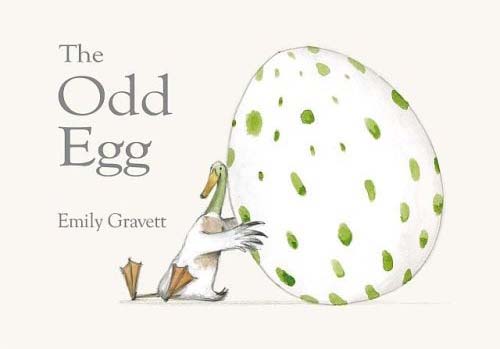
The Odd Egg
The Odd Egg. written and illustrated by Emily Gravett. 2008. 32p. New York: Simon and Schuster.
Author/Illustrator Website: www.emilygravett.com
Medium: pencil and watercolor
Awards and Honors: none
Audience:4 and up
Annotation:
All of the birds have laid eggs- everyone except Duck. When he finds a large speckled egg, he adopts it as his own and waits patiently for it to hatch.
Personal Reaction:
All of the birds have laid eggs- everyone except Duck (which is not too surprising, really, given the fact that Duck is a male mallard). When Duck finds a large speckled egg, he adopts it as his own and waits patiently for it to hatch. The other birds think he's silly, of course.
Soon the eggs begin to hatch in a spectacular sequence illustrated by a series of graduated "lift-the-flap" pages. The babies all pop out from their eggs, each one more impressive than the one before it. All of the eggs break open besides Duck's, but he's not phased. Instead he begins to knit a scarf and a set of mittens while he waits for his egg to hatch.
And hatch it does, unleashing a rather feisty baby alligator who sends the other birds flapping. Children will no doubt guess the "surprise" ending before it comes, but it won't detract from the story. A final, adorable illustration shows the alligator in its scarf and mittens following attentively behind Duck and cooing, "Mama".
Author/Illustrator Website: www.emilygravett.com
Medium: pencil and watercolor
Awards and Honors: none
Audience:4 and up
Annotation:
All of the birds have laid eggs- everyone except Duck. When he finds a large speckled egg, he adopts it as his own and waits patiently for it to hatch.
Personal Reaction:
All of the birds have laid eggs- everyone except Duck (which is not too surprising, really, given the fact that Duck is a male mallard). When Duck finds a large speckled egg, he adopts it as his own and waits patiently for it to hatch. The other birds think he's silly, of course.
Soon the eggs begin to hatch in a spectacular sequence illustrated by a series of graduated "lift-the-flap" pages. The babies all pop out from their eggs, each one more impressive than the one before it. All of the eggs break open besides Duck's, but he's not phased. Instead he begins to knit a scarf and a set of mittens while he waits for his egg to hatch.
And hatch it does, unleashing a rather feisty baby alligator who sends the other birds flapping. Children will no doubt guess the "surprise" ending before it comes, but it won't detract from the story. A final, adorable illustration shows the alligator in its scarf and mittens following attentively behind Duck and cooing, "Mama".
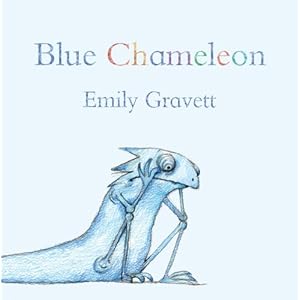
Blue Chameleon
Blue Chameleon. written and illustrated by Emily Gravett. 2010. 32p. New York: Simon and Schuster.
Author/Illustrator Website: www.emilygravett.com
Medium: colored pencil on rough watercolor paper
Awards and Honors:
Audience: 1 and up
Annotation:
A chameleon tries changing color and shape in order to find a friend.
Personal Reaction:
An undeniable, yet charming, take on Leo Lionni's A Color of His Own, Blue Chameleon is the story of a lonely chameleon who tries changing color and shape in order to find where he fits in. He mimics everything from a banana, to a snail, to a sock, before he becomes discouraged and turns as white as the page he's on. It takes a sharp eye to make out the faintest outline of another claw that creeps onto the page where the chameleon lies pale and defeated. Readers turn the page to discover that the chameleon has found a friend- another chameleon who turns brightly colored in its excitement at having met someone similar. Gravett's clever illustrations and spartan narration make the story engaging and heartfelt.
The Nice Book
The Nice Book. written and illustrated by David Ezra Stein. 2008. 32p. New York: G.P. Putnam's Sons.
Author/Illustrator Website: www.davidezra.com
Medium: acyrlic paint, inks, china marker and digital
Awards and Honors: none
Audience: 2 and up
Annotation:
A menagerie of animals demonstrate what it means to be nice to others.
Personal Reaction:
The Nice Book demonstrates in simple pictures and words what it means to be nice to others. Monkeys hug, warthogs share and horses nuzzle, while other animals demonstrate behavior that is not so nice- snakes squeeze, a toad stares, and birds hit. Text appears in a variety of fonts, colors, shapes and sizes, echoing the actions it describes. Stein's appealing illustrations resemble finger paint creations, loose and almost child-like in their execution. This book is sure to spark conversation about what is- and isn't- nice among kids and parents.
Author/Illustrator Website: www.davidezra.com
Medium: acyrlic paint, inks, china marker and digital
Awards and Honors: none
Audience: 2 and up
Annotation:
A menagerie of animals demonstrate what it means to be nice to others.
Personal Reaction:
The Nice Book demonstrates in simple pictures and words what it means to be nice to others. Monkeys hug, warthogs share and horses nuzzle, while other animals demonstrate behavior that is not so nice- snakes squeeze, a toad stares, and birds hit. Text appears in a variety of fonts, colors, shapes and sizes, echoing the actions it describes. Stein's appealing illustrations resemble finger paint creations, loose and almost child-like in their execution. This book is sure to spark conversation about what is- and isn't- nice among kids and parents.
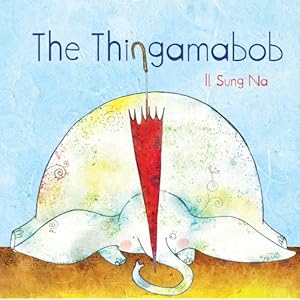
The Thingamabob
The Thingamabob. written and illustrated by Il Sung Na. 2008. 24p. New York: Alfred A. Knopf.
Author/Illustrator Website: www.ilsungna.com
Medium: handmade paint textures combined with digital layers using Adobe Photshop
Awards and Honors: none
Audience: 2 and up
Annotation:
An elephant encounters a strange, new object for which he tries to find a purpose.
Personal Reaction:
A ponderous pink-cheeked elephant is out for a stroll when he finds a strange object- a bright red umbrella. He has no idea what the "thingamabob" is or where it came from so he asks his friends, who are just as clueless as he is. He experiments a bit with the thingamabob, to humorous effect- hiding behind it, sailing in it, trying to fly with it. Only after it suddenly begins to rain, does Elephant finally discover what the "thingamabob" is for, when he and his friends crown under the umbrella to seek shelter from the storm.
This is a simple, and highly enjoyable story for young children, who will delight in knowing exactly what the "thingamabob" is from the very beginning. Na's beautifully textured illustrations are eye-catching- particularly the endpapers, which feature a plethora of patterned umbrellas.
Duck! Rabbit!
Duck! Rabbit!. written by Amy Krouse Rosenthal. illustrated by Tom Lichtenheld. 2009. 40p. San Francisco: Chronicle Books.
Author Website: www.whoisamy.com
Illustrator Website: www.tomlichtenheld.com
Medium: ink, watercolor, colored pencil
Awards and Honors: American Library Association Notable Children's Book of 2010, Publishers Weekly Best Children's Books of the Year, 2009, Booklist 2009 Editors' Choice
Audience: 2 and up
Annotation:
Two characters argue over whether the animal they see before them is a duck or a rabbit.
Personal Reaction:
This book is both a clever take on a confounding optical illusion and a satisfying exploration of how different points of view can both be correct. As two offstage characters argue over whether the animal before them is a duck or a rabbit, they each give evidence of their own point of view. It would seem that each has convinced the other... just as the animal runs away. But the characters are faced with another conundrum when an anteater/brachiosaurus appears placidly munching on a pile of ants/the leaves of a tree...
This is a book with excellent read aloud appeal or potential for a puppet show. Use it with children to discuss the value of different perspectives.
An Awesome Book!
An Awesome Book!. written and illustrated by Dallas Clayton. 2012. 64p. New York: HarperCollins.
Author/Illustrator Website: dallasclayton.com
Medium: watercolor and ink
Awards and Honors: none
Audience:4 and up
Annotation:
An imaginative and beautiful exhortation to children (or grownups) to dream big.
Personal Reaction:
I picked this book up not knowing what it was all about, but the cover- featuring a furry frog about to swallow a globe- intrigued me. What I found was a little gem of a book, full of fanciful illustrations and inspiring words.
This book was originally created by artist Dallas Clayton as a gift for his young son, a reminder to to never stop pursuing his dreams, no matter how silly they seem. The poetic ponderings- of rocket-powered unicorns and magic watermelon boats- and the whimsical accompanying illustrations evoke Shel Silverstein in their off-kilter joyfulness. The message of hope and imagination will resonate strongly with adults as well as children.
No, David!
No, David!. written and illustrated by David Shannon. 1998. 32p. New York: Scholastic Press.
Author/Illustrator Website: http://www.scholastic.com/titles/nodavid/davidshannon.htm
Medium: oil
Awards and Honors: Caldecott Honor, New York Times Best Illustrated Book, SLJ Best Book
Audience: 2 and up
Annotation:
A gleefully naughty preschooler finds all sorts of ways to get himself in trouble, much to the chagrin of his exasperated mother.
Personal Reaction:
Snaggle-toothed, lumpy headed David is the ultimate mischief-maker. He bangs pots and pans, plays with his food, tracks dirt in the house and even runs down the street sans clothes, while his exasperated mother vainly attempts to rein him. When finally David breaks his mother's vase he is repentant, and runs into the unconditionally loving arms of his mother, who reassures him, "Yes, David... I love you!".
No, David! is an exuberant romp of a book. Filled with visual jokes accompanied by the refrain, "No, David!", this book imagines all of the ways a naughty little boy could manage to make trouble. Each page will be met with roars of laughter from young children and nods from knowing parents.
Labels:
0-4,
assignment 6,
Caldecott Honor,
humorous stories
I'm The Biggest Thing in the Ocean
I'm The Biggest Thing in the Ocean. written and illustrated by Kevin Sherry. 2007. on board pages. New York: Dial Books for Young Readers.
Author/Illustrator Website: kevinsherryonline.com
Medium: watercolor and gouache
Awards and Honors: an E.B. White Award Finalist, a Marion Vannett Ridgway Honor Book
Audience:2 and up
Annotation:
A giant squid swims gleefully about the ocean, noting everything that he is bigger than.
Personal Reaction:
I'm The Biggest Thing in the Ocean is a silly and lighthearted book about a gleefully proud giant squid who proclaims himself the "biggest thing in the ocean"! The squid swims happily about pointing out all the other animals that he is bigger than: some shrimp, an octopus, some clams, a shark (shhh!). When the giant squid is swallowed by a whale, he is momentarily surprised, but hardly skips a beat. After assessing the other animals in the whales belly, he cheerfully proclaims, "I'm the biggest thing in this whale!".
This fun tale is cheerfully illustrated in tones of green and turquoise. Sherry's repetitive text and cartoonish characters is sure to hold massive appeal to toddlers and preschoolers.
Extra Yarn
Extra Yarn. written by Mac Barnett. illustrated by Jon Klassen. 2012. 40p. New York: Balzer and Bray.
Author Website: www.macbarnett.com
Medium: watercolors, digitally manipulated
Awards and Honors: none
Audience:4 and up
Annotation:
A young girl finds a magical box of endless yarn which is subsequently stolen by an evil archduke.
Personal Reaction:
Annabelle lives in a dreary little town where everything is cold and gray. The trees, the houses, the animals, and even the people all exist in shades of black and white. But when Annabelle finds a box filled with rainbow colored yarn, that all begins to change. She knits a sweater for herself and one for her dog, but there is still extra yarn. So she knits a sweater for Nate and his dog. And one for her classmates and her teacher. And another for her mom and dad. And ones for all the animals in town. But there is still extra yarn. So Annabelle decides to knit sweaters for all the houses, and the mailboxes, and the cars. And yet her yarn never runs out.
With all of those rainbow colored sweaters her monochromatic town begins to change, attracting people from near and far. One person who comes has nefarious intentions. An evil archduke steals the magical box of yarn, yet when he sits down to open it, he finds it completely empty. Angrily he tosses it into the sea... where it is reunited with its rightful owner.
The story is great- quirky, whimsical, with the feel of a modern fairytale- but its Jon Klassen's illustrations that make it shine. His buildings and people and animals are completely charming, even when they're dreary and gray. And when they appear clad in rainbow sweaters, it's magic. Klassen's chunky, colorful sweaters are cheerful, but not brash. Fans of I Want My Hat Back will be happy to note that the churlish Bear makes an appearance in this book.
Annabelle lives in a dreary little town where everything is cold and gray. The trees, the houses, the animals, and even the people all exist in shades of black and white. But when Annabelle finds a box filled with rainbow colored yarn, that all begins to change. She knits a sweater for herself and one for her dog, but there is still extra yarn. So she knits a sweater for Nate and his dog. And one for her classmates and her teacher. And another for her mom and dad. And ones for all the animals in town. But there is still extra yarn. So Annabelle decides to knit sweaters for all the houses, and the mailboxes, and the cars. And yet her yarn never runs out.
With all of those rainbow colored sweaters her monochromatic town begins to change, attracting people from near and far. One person who comes has nefarious intentions. An evil archduke steals the magical box of yarn, yet when he sits down to open it, he finds it completely empty. Angrily he tosses it into the sea... where it is reunited with its rightful owner.
The story is great- quirky, whimsical, with the feel of a modern fairytale- but its Jon Klassen's illustrations that make it shine. His buildings and people and animals are completely charming, even when they're dreary and gray. And when they appear clad in rainbow sweaters, it's magic. Klassen's chunky, colorful sweaters are cheerful, but not brash. Fans of I Want My Hat Back will be happy to note that the churlish Bear makes an appearance in this book.
Saturday, May 12, 2012
A Good Day
A Good Day. written and illustrated by Kevin Henkes. 2007. 32p. New York: Greenwillow Books.
Author/Illustrator Website: www.kevinhenkes.com
Medium: watercolor and ink
Awards and Honors: ALA Notable Children's Book
Audience: 1 and up
Annotation:
A bird, a dog, a fox and a squirrel all experience momentary losses but quickly turn their bad days around.
Personal Reaction:
When young children experience setbacks, small disappointments can quickly escalate into huge tragedies. A Good Day shows how four young animals- a bird, a dog, a fox and a squirrel- all overcome bad moods and turn their days around.
A Good Day recalls Henkes' Caldecott winning Kitten's First Full Moon, both in theme and stylistically, with its thick, chunky lines and defined panels. If anything, these illustrations seems even more confident; the compositions are strong and self-assured, and the colors bright and bold.
This is a pleasant little book, with a resounding message that is important for children to learn. Simple wording and structure make it particularly excellent for sharing with young children.
Hattie and the Fox
Hattie and the Fox. written by Mem Fox. Illustrated by Patricia Mullins. 1987. 32p. New York: Simon and Schuster.
Author Website: www.memfox.net
Illustrator Website: www.patriciamullins.com.au
Medium: tissue paper and conte crayon
Awards and Honors: none
Audience: 3 and up
Annotation:
Hattie the hen tries to warn the other barnyard residents of impending danger.
Personal Reaction:
Hattie the big black hen lives on a farm with a goose, a pig, a sheep, a horse and a cow. One day she notices something in the bushes and tries to warn the other animals, who reply with rather resounding apathy- "Well, well", says the pig; while the sheep says, "Who cares?; and the cow says, "What next?. As the thing in the bushes gets closer and Hattie sees more of it- a nose, two eyes, two ears, etc.- Hattie tries again and again to warn the other animals, but to no avail.
When finally the thing in the bushes emerges, Hattie sees clearly that it is a fox and flies into a nearby tree. It's only then that the animals react, crying out, "Oh, no!" and "Dear me!". The cow, however, says, "MOO!" so loudly that it scares the fox away and afterwards they all remain silent for a long time.
As this cumulative tale builds, so does the tension and it ends with a satisfying surprise when the cow moos with all its might. The looks on the faces of the frightened animals at the close of the story are priceless; they all stand wide-eyed and stiff- everyone except Hattie, of course, who remains safely perched high up in the crook of a tree.
Orange Pear Apple Bear
Orange Pear Apple Bear. written and illustrated by Emily Gravett. 2007. 32p. New York: Simon and Schuster.
Author/Illustrator Website: www.emilygravett.com
Medium: pencil and watercolor
Awards and Honors: A SLJ Best Book of the Year, An ALA Notable Children's Book, A Bulletin Blue Ribbon Book, A Kirkus Reviews Best Children's Book of the Year, A Publisher's Weekly Best Book of the Year, One of New York Public Library's 100 Titles for Reading and Sharing
Audience: 0 and up
Annotation:
Using only 5 words, a bear and three pieces of fruit, this book explores colors, shapes and language.
Personal Reaction:
Orange, pear, apple, bear.
This book uses these four words, arranging and rearranging them to create a simple and playful story for very young children. With delicate washes of watercolors on white pages, Gravett first shows each object on its own page. It's simple enough, but Gravett then begins to combine or rearrange the words, adding or dropping commas, to change up the meaning entirely. One spread shows a pear the color of autumn leaves and a very round, very green bear- "Orange pear. Apple bear". As the book continues, the bear begins to juggle and then eat the fruits. The back end pages show the cores and peels of the consumed fruits.
This book has immense appeal, both for Gravett's cleverly simple word games and her loose and lovely watercolors. A great choice for beginning readers, as well as very young children.
Author/Illustrator Website: www.emilygravett.com
Medium: pencil and watercolor
Awards and Honors: A SLJ Best Book of the Year, An ALA Notable Children's Book, A Bulletin Blue Ribbon Book, A Kirkus Reviews Best Children's Book of the Year, A Publisher's Weekly Best Book of the Year, One of New York Public Library's 100 Titles for Reading and Sharing
Audience: 0 and up
Annotation:
Using only 5 words, a bear and three pieces of fruit, this book explores colors, shapes and language.
Personal Reaction:
Orange, pear, apple, bear.
This book uses these four words, arranging and rearranging them to create a simple and playful story for very young children. With delicate washes of watercolors on white pages, Gravett first shows each object on its own page. It's simple enough, but Gravett then begins to combine or rearrange the words, adding or dropping commas, to change up the meaning entirely. One spread shows a pear the color of autumn leaves and a very round, very green bear- "Orange pear. Apple bear". As the book continues, the bear begins to juggle and then eat the fruits. The back end pages show the cores and peels of the consumed fruits.
This book has immense appeal, both for Gravett's cleverly simple word games and her loose and lovely watercolors. A great choice for beginning readers, as well as very young children.
Kitten's First Full Moon
Kitten's First Full Moon. written and illustrated by Kevin Henkes. 2004. 40p. New York: Greenwillow Books.
Author/Illustrator Website: www.kevinhenkes.com
Medium: colored pencil and gouache
Awards and Honors: Caldecott Medal
Audience: 2 and up
Annotation:
When Kitten sees the full moon for the first time, she thinks that it's a bowl of milk and she tries to catch it.
Personal Reaction:
When plucky little Kitten sees the full moon for the first time, she thinks that it's a bowl of milk and she tries to catch it. She jumps from the top step of the porch, but she only succeeds in falling down. She tries to chase it down, but it never gets any closer. But Kitten is very persistent. She climbs up to the top of a tree to try to get nearer to the moon and she jumps into the pond to try to catch the reflection, but none of these things work! Finally, she goes back home to find that her owner has left a great big bowl of milk on the porch for her.
In Kitten's First Full Moon Henkes puts a different spin on his distinctive style of illustration by working entirely in shades of black and grey. It makes sense for the subject matter- a moonlit night- and also helps temper the inherent cuteness of Kitten. The book works well as a read-aloud- kids will enjoy joining in the refrain "poor kitten!".
Labels:
0-4,
assignment 6,
Caldecott Honor,
Caldecott Medal
First The Egg
First The Egg. written and illustrated by Laura Vaccaro Seeger. 2007. 32p. New Milford, CT: Roaring Brook Press.
Author/Illustrator Website: www.studiolvs.com
Medium: oil on canvas
Awards and Honors:
2008 Caldecott Honor Book, 2008 Theodor Seuss Geisel Honor Book,
New York Times Best Seller, A New York Times Best Illustrated Book of 2007, American Library Association Notable Children’s Book, 2008, A Horn Book Fanfare Best Book of 2007, Oppenheim Platinum Award, 2008, NAIBA Children’s Pick of the List, 2007, Arizona Grand Canyon Young Readers Award, 2007, Michigan Great Lakes Great Books Award, 2007, South Dakota Prairie Bud Award, 2007, Eric Carle Museum Picture Book of Distinction, 2007
Audience: 2 and up
Annotation:
Laura Vaccaro Seeger creatively explores the age-old question: what came first, the chicken or the egg?
Personal Reaction:
This little book celebrates the miracle of creation, both natural and artistic. Using strategically place die-cuts, Laura Vaccaro Seeger takes the reader through transformations- from the egg, to the chicken; the tadpole, to the frog; the word, to the story; the paint, to the picture; and the chicken back to the egg. Naturally, the cyclical progression elicits calls for repeated readings from children who delight in guessing what each object will become. Seeger's thickly applied oil on canvas illustrations are unique, if a bit flat at times.
Subscribe to:
Posts (Atom)