Showing posts with label curriculum connection. Show all posts
Saturday, August 6, 2011
The Extraordinary Mark Twain (According to Susy)
by Barbara Kerley, illustrated by Edwin Fotheringham. 2010. New York: Scholastic Press. (9780545125086).
Author Website: http://www.barbarakerley.com/Site/Welcome.html
Illustrator Website: http://www.edfotheringham.com/
Media: digital media
Awards and Honors: A Junior Library Guild Selection; Kirkus, starred review; School Library Journal, starred review; Publishers Weekly, starred review
Annotation:
Much ink has been spilled writing about Samuel Langhorne Clemens, the man the world knows as Mark Twain, but did you know that his closest biographer was Susy Clemens, his young daughter?
Personal Reaction:
The Extraordinary Mark Twain (According to Susy) is an illuminating look at Mark Twain, the husband and father. Written from anecdotes compiled by Susy Clemens, Twain's young daughter, it offers entertaining, personal observations on the man that many thought they understood, but few really knew. Susy, determined to "set the record straight" on her "Papa", wrote a revealing biography of him in her own diary and Kerley uses actual excerpts in the book. These are included as neat journal inserts in flowy handwriting font. Fotheringham's digital illustrations are sometimes flat looking, as digital drawing are often wont to be, but his caricatures of Twain are expressive and spot-on. An author's note at the ends offers more details of Mark Twain, Susy and their close relationship, a timeline of Twain's life and tips on writing an extraordinary biography.
Curriculum Connection:
Upper Elementary/Middle School Language Arts and Social Studies
Lesson Plan:
Teacher:
Diana Garcia
Subject Area:
Language Arts/Social Studies
Suggested Grade Level:
5-7
Lesson Title:
Writing Biographies
Overview:
Students will learn about biographies- what one is, how to create one- and will pair off with a classmate and create a short biography of them.
Time:
2-3 hours
Materials/Equipment Required:
- The Extraordinary Mark Twain (According to Susy) by Barbara Kerley
- notebooks
- pencils
Objectives:
Students will learn about the process of writing a biography and will practice by pairing together with a classmate, interviewing and writing a biography about them. Students will learn to research, conduct inquiries, organize and summarize information into well-written mini-biographies.
Suggested Procedure:
Teacher will read aloud The Extraordinary Mark Twain (According to Susy) and lead a discussion of Susy and her biography of “Papa”.
Teacher will distribute the handout “Writing an Extraordinary Biography” (available at www.barbarakerley.com/ teachers.html) to students and they will read it together and discuss how to:
1. gather information by conducting interviews and taking notes
2. how to get facts straight about people, places, dates, events, quotes
3. bring the subject to life by including details, quotations, lots of examples
4. create a well-rounded portrait of their subject by showing difficulties and successes, good and bad habits, serious and funny sides
Teacher will ask students to pair off and interview each other. Example questions are:
- Where were you born?
- Who are the members of your family
- Where do you live?
- Who is your best friend?
- What do you want to be when you grow up?
- What is your best quality?
- What is your worst habit?
- Tell me a funny story about your family/friends?
Students will takes turns being the interviewer/subject, taking notes, etc.
Students will produce a short 1 to 2 page biography of each other.
Additional Resources:
Allow students to explore biographies of famous people in the library, or on biography.com or the Biography Resource Center database (if available)
Labels:
2010/2011,
curriculum connection,
lesson plan
Friday, August 5, 2011
Jabberwocky
Jabberwocky
reimagined and illustrated by Christopher Myers. 2007. New York: Hyperion Books for Children. (9781423103721).
Media: watercolor and acrylic paints
Author/Illustrator Website: none
Awards and Honors: Booklist, Starred Review
Annotation:
A creative reimagining of Jabberwocky, Lewis Carroll's famous poem from Through the Looking Glass, and What Alice Found There.
Personal Reaction:
Christopher Myers' colorful and creative spin on the most famous gibberish verse in the English language bristles with energy and dynamism. Myers has (through research and a few artistic liberties) transformed a poem that is ostensibly about a knight who slays a monster into a modern verse about a one-on-one basketball challenge. The Jabberwocky becomes a dark, hulking, 13-fingered giant with glowing eyes and flashing teeth. The hero is a boy who appears, sneakers in hand, to challenge the monster on the court. He makes quick work of the Jabberwocky ("One, two! One, two! And through, and through") and struts off the court dribbling the basketball. Myers accompanies the action with illustrations that set up the context- children running through opened fire hydrants, playing double-dutch and shooting marbles. This contemporary interpretation would be an excellent way to introduce a classic poem to students, or to supplement curriculum on British literature.
Curriculum Connection: Middle school language arts- poetry
Energy Island: How One Community Harnessed the Wind and Changed Their World
written and illustrated by Allan Drummond, 2011. New York: Farrar, Straus and Giroux. (9780374321840).
Media: pen and ink with watercolor
Author/Illustrator Website: http://www.allandrummond.com/
Awards and Honors: Booklist, Starred Review; Kirkus Reviews; Los Angeles Times; New York Times Book Review; Publishers Weekly; School Library Journal, Starred Review
Annotation:
This is the story of the people of Samso, an island in Denmark, who by thinking creatively and working together were able to become almost completely energy independent.
Personal Reaction:
Energy Island: How One Community Harnessed the Wind and Changed Their World tells the story of Samso, an island in Denmark, that has changed the ways in which they use and create energy. Allan Drummond makes an important topic eminently accessibly through his engaging prose and cheerful, cartoon-like illustrations. Green sidebars present factual information about topics such as global warming, fossil fuels, and renewable energy sources. It's an optimistic and encouraging take on a topic that can be very heavy (for children as well as adults). Drummond shows readers how a really daunting issue can be solved through some new ideas, the perseverance of a devoted few, and the hard work of the entire community.
Curriculum Connection: Elementary or middle school science- green energy
Lesson Plan:
Subject Area:
Environmental Science
Suggested Grade Level:
3-6
Lesson Title:
Learning about Energy
Overview:
Students will learn about alternative energy sources.
Time:
2-3 hours
Materials/Equipment Required:
- Energy Island: How One Community Harnessed the Wind and Changed Their World by Allan Drumond
- computer with internet access and projector
Each student will need:
- scissors
- 4 small paper cups (like drinking cups)
- A marking pen (any color)
- 2 strips of stiff, corrugated cardboard -- the same length
- Ruler
- Stapler
- Push pin
- Sharpened pencil with eraser on the end
- Modeling clay
- A watch that shows second
Objectives:
Students will learn about energy sources, explore ways to save energy, think of ways to reduce their impact on the environment and build an anemometer.
Suggested Procedure:
Teacher will read aloud Energy Island and lead a discussion about the ways in which their community generates and uses energy. Teacher will write the ways on the board.
Class will brainstorm ways to help save the environment (i.e. switch to clean energy, use less energy and energy efficient appliances, watch water usage, recycle materials, reuse materials, buy things with less packaging, plant a tree)
Teacher will explore with students the EPA’s website (http://www.epa.gov/ climatechange/kids/solutions/technologies/index.html), focusing on the ways that renewable energy can be created.
Class will learn about the US Department of Energy’s Wind for Schools project that installs wind turbines at rural schools (http://www.windpoweringamerica.gov/schools.asp).
Students will create their own anemometers, following the instructions at http://www.energyquest.ca.gov/projects/anemometer.html. Students can measure the relative wind speed at various locations around their school.
Additional Resources can be found at:
http://www.windpoweringamerica.gov/schools_teaching_materials.asp
Labels:
2010/2011,
curriculum connection,
lesson plan
Thursday, August 4, 2011
Back of the Bus
Back of the Bus
by Aaron Reynolds, illustrated by Floyd Cooper. 2010. New York: Penguin Group. (9780399250910).
Author Website: http://www.aaron-reynolds.com/
Illustrator Website: http://www.floydcooper.com/
Media: oil paint
Annotation:
The story of Rosa Parks, as seen through the eyes of a young boy on the Montgomery, Alabama bus that fateful day in 1955.
Personal Reaction:
Aaron Reynolds imagines Rosa Park's 1955 act of civil disobedience on a Montgomery, Alabama bus in his book Back of the Bus. This is the famous story as seen through the eyes of a young African American boy. The nameless boy and his mother witness firsthand Rosa Park's refusal to move from her seat and her subsequent arrest. The boy is nervous but his mother assures him (somewhat ironically) that, "Tomorrow all this'll be forgot". Reynolds writes in the boy's voice, using vernacular language which I find demeaning and borderline offensive most of the time. (The boy says things like, "I want me a drink real bad".) While there's nothing terrible about the book, there's nothing particularly spectacular about it either. Floyd Cooper's illustrations are nice, but he's done better work (see Joyce Carol Thomas' I Have Heard of the Land or Pat Sherman's Ben and the Emancipation Proclamation).
by Aaron Reynolds, illustrated by Floyd Cooper. 2010. New York: Penguin Group. (9780399250910).
Author Website: http://www.aaron-reynolds.com/
Illustrator Website: http://www.floydcooper.com/
Media: oil paint
Annotation:
The story of Rosa Parks, as seen through the eyes of a young boy on the Montgomery, Alabama bus that fateful day in 1955.
Personal Reaction:
Aaron Reynolds imagines Rosa Park's 1955 act of civil disobedience on a Montgomery, Alabama bus in his book Back of the Bus. This is the famous story as seen through the eyes of a young African American boy. The nameless boy and his mother witness firsthand Rosa Park's refusal to move from her seat and her subsequent arrest. The boy is nervous but his mother assures him (somewhat ironically) that, "Tomorrow all this'll be forgot". Reynolds writes in the boy's voice, using vernacular language which I find demeaning and borderline offensive most of the time. (The boy says things like, "I want me a drink real bad".) While there's nothing terrible about the book, there's nothing particularly spectacular about it either. Floyd Cooper's illustrations are nice, but he's done better work (see Joyce Carol Thomas' I Have Heard of the Land or Pat Sherman's Ben and the Emancipation Proclamation).
Busing Brewster
Busing Brewster
by Richard Michelson, illustrated by R.G. Roth. 2010. New York: Alfred A. Knopf. (9780375933349)
Media: ink, watercolor and collage
Author Website: http://richardmichelson.com/
Illustrator Website: none
Awards and Honors: New York Times: 10 Best Illustrated Books of 2010,
New York Times: 8 Notable Children’s Books of 2010, National Council for the Social Studies and Children's Book Council Notable Social Studies Trade Book for Young People 2011
Annotation: In 1971, Brewster becomes one of the first African American children to integrate the fictional Central School after the Supreme Court implements forced 'busing'.
Personal Reaction:
In 1971, the United States Supreme Court implemented forced busing in an attempt to integrate public schools. Some black children were bused to white schools outside their neighborhoods and were met with racial hostility from the families of the new schools they were attending. This is the fictional story of Brewster, a young boy who becomes one of the first students to integrate Central School. Richard Michelson presents a short, simple story on a large topic as told through the eyes of a very young child just entering first grade. Because Brewster is too young to understand the implications of much of what is happening around him, it's a gentle introduction to a complex issue. In this regard Busing Brewster is much like Benno and the Night of Broken Glass, which introduces a troubling period of history by telling the story of Kristallnacht through the eyes of a neighborhood cat in Berlin. R.G. Roth's child-like illustrations, rendered in watercolor and collage, are even reminiscent of Josée Bisaillon's non-threatening illustrations from Benno and the Night of Broken Glass. Though Michelson does touch on the violence and ignorance Brewster experiences (a rock is thrown through the bus window by protesting parents and a student makes a racist comment to Brewster at school), it's kept at a gentle level to make the story accessible by younger kids. The ignorance is also tempered by an encouraging librarian, Miss O'Grady who reads to Brewster and encourages his dream of one day becoming president
Curriculum Connection: Elementary social studies, Civil Rights
Monday, August 1, 2011
Ubiquitous: Celebrating Nature's Survivors
by Joyce Sidman, illustrated by Beckie Prange, 2010. New York: Houghton Mifflin Books for Children. (978061871794).
Author Website: www.joycesidman.com
Illustrator Website: http://www.beckieprange.com/
Media: linocuts, hand-painted with watercolor
Awards and Honors: Starred reviews in Booklist, Publishers Weekly, School Library Journal, Kirkus, Horn Book; Junior Library Guild Selection; Publisher's Weekly, Best Books of the Year; Washington Post, Best Books of the Year; Kirkus, Best Books of the Year; School Library Journal, Best Books of the Year; National Science Teachers Association/Children's Book Council, Outstanding Science Trade Books, K-12, 2011; Boston Globe, Top Ten Children's Books of 2010; New York Public Library's "100 Best Books"; Booklist, Top 10 Sci-Tech for Youth; Book Links, Lasting Connections for 2010; Finalist for the 2011 CYBILS Poetry Award; Association for Library Service to Children Notable Children's Book; The John Burroughs List of Nature Books for Young Readers
Annotation:
Joyce Sidman's poetic tribute to some species that have been spectacularly successful from an evolutionary point of view.
Personal Reaction/Discussion of Artwork:
Joyce Sidman is a master of using poetry to teach children about science and nature. In Ubiquitous her compelling verses, paired with Beckie Prange's illustrations, tell the story of some of Earth's most successful species.
Prange's lovely hand-colored linocut prints are gorgeously composed and bold while still retaining a charming rawness. Her illustrations exhibit so much variety that they keep a real energy about the book. One page may show the moon as seen from the perspective of someone laying in the grass, while another presents lichens, seven times their actual size, spreading gracefully across the page, and yet another shows the lifecycle of the dung beetle as a circle of spheres on a blank white page. The endpapers in particular are really spectacular- Prange has created a timeline to show when the various lifeforms appeared on Earth using a string 46 meters long, coiled and looped, each centimeter equalling 1 million years. The string gently shifts in color, from red to orange to yellow, and through the colors of the rainbow, to represent changes in the Earth's geologic periods. Of the fourteen species represented on the timeline only one, bacteria, appears on the left hand side of the spread. The other thirteen are bunched up towards the end of the timeline, and humans appear at the very tip of the string. It's an effective way to visually represent how young humans really are as a species.
Sidman's poems are as delightfully varied in form as the species they discuss. They range from a rapid-fire stream of consciousness rant by a squirrel, to a classical ode on a mollusk's shell, to a poem about sharks in the shape of (what else?) a shark. Opposite each poem is a short factual paragraph about each species, explaining the special characteristics that have made them successful on Earth. As with Sidman's other works, you're never quite sure if this is a book of poems masquerading as science, or an informational volume dressed up as art. Ubiquitous is an visually arresting, inventive, and sometimes whimsical blurring of the division between art and science.
Allusion: "... I am Sheath-wing, beloved of ancients... As the sun-god rolls his blazing disk overhead, so I roll my perfect sphere of dung across the sands... Blessed by the gods are you who hold me in your hands."
- refers to the worship of the dung, or scarab, beetle by ancient Egyptians and the parallels drawn between the beetle and the sun god, Ra
Personification:
"Did you know/ dandelions grow the hair/ just as we do?/ Each pale, silky thread/ springs straight/ from their head./ They were all blondes,/ of course,/ and each one/ a star."
Curriculum Connection:Elementary school science- Biology
Labels:
2010/2011,
allusion,
artwork,
curriculum connection,
poetry
Saturday, July 30, 2011
Bones: Skeletons and How They Work
written and illustrated by Steve Jenkins, 2010, New York : Scholastic Press. (0545046513).
Author/Illustrator Website: http://www.stevejenkinsbooks.com/
Media: paper collage
Awards and Honors: A Junior Library Guild Selection for Fall 2010, A Society of Illustrators Original Art Show choice
Annotation: A creative look at bones and skeletons of all shapes and sizes, what they do, and how they do it.
Personal Reaction:
This is a wonderful picture book for children who are fascinated by bones or for educators to enrich lessons on the skeleton (human and otherwise). Steve Jenkins employs his trademark paper collage illustrations to explain how bones protect, support, and enable movement for all vertebrates. Cream collage skeletons on boldly colored solid pages are attention grabbers and Jenkins uses fold out double spreads to great effect in illustrating some spectacular full skeletons. One really neat feature of the illustations is that they are done to scale so that the reader can compare the sizes of various bones and animals. Jenkins includes additional facts, stories, history and science relating to bones at the end of the book. This is a book that elementary age kids (especially boys) will want to read again and again.
Curriculum Connection: Elementary school biology
Lesson Plan:
Subject Area:
Biology
Suggested Grade Level:
4-5
Lesson Title:
Bones
Time:
1-2 hours
Materials/Equipment Required:
- Bones: Skeletons and How They Work written and illustrated by Steve Jenkins
- modeling clay
- paper
- tape
- paper or plastic plates
- weights (wooden blocks)
Objectives:
Students will learn about bones (the different types, how they protect the body, support it and allow it to move) and joints in the human body.
Suggested Procedure:
Teacher will read aloud Bones: Skeletons and How They Work.
Bone and Joint Activity:
1) Teacher will show students a picture of a bone pointing out the
various parts of the bone, and reviewing important vocabulary.
2) Students will create a clay model of the bone, labeling the parts
of it.
3) Teacher will introduce the four joints of the human body.
4) The teacher will demonstrate the movements of the joints.
5) Students will brainstorm examples in the human skeletal system for each type of joint.
Bone Strength Activity:
1) Students will roll up half a sheet of letter-sized paper into a cylinder about 1 inch wide. They will make 3 of these.2) Students will stand the bones up on their ends and place a paper plate on top of the bones.
3) Students will begin to add weights (wooden blocks) to the plate.
4) Students will count how many blocks the plate can hold before the “bones" collapse.
5) Students will roll 3 more sheets of paper as tightly as they can so that there is no hollow section
6) Students will stand these "bones" up as before placing the same plate on top of them.
7) Students will place weights on top of the plate until they collapse.
8) Students will deduce what happened. Teacher will explain that hollow
bones were able to support more weight. Teacher will continue explaining that the large bones in our body are also hollow, which makes them strong so they can support more weight, but light, so it takes less energy to move them.
Labels:
2010/2011,
curriculum connection,
lesson plan
Benno and the Night of the Broken Glass
by Meg Wiviott, illustrated by Josee Bisaillon, 2010. Minneapolis, Minnesota: Kar-Ben Publishing. (978082259929).
Media: collage, drawings and digital editing
Author Website: http://megwiviott.com/
Illustrator Website: joseebisaillon.com
Awards and Honors: Selected as one of School Library Journal's Best Books 2010: Picture Books; Winner of Moonbeam Children's Book Awards' Gold Medal for Multi-cultural Picture Book; CCBC's 2011 Best Choice List
Annotation:
A picture book portrayal of Kristallnacht (The Night of Broken Glass) in Nazi Germany as seen through the eyes of Benno, the neighborhood cat.
Personal Reaction:
The human atrocities committed by Nazi Germany are a troubling and complex subject to teach to young children, but Benno and the Night of the Broken Glass is a sensitive and thoughtful introduction to the Holocaust. The violence is largely implied, and while it is jarring, it is not explicit or disturbing. By telling the story through the eyes of Benno, the neighborhood cat, readers are given a first-hand look at the destruction and persecution by an objective narrator. Because Benno is a neutral participant he describes the outward appearance of the events and doesn't delve into significance. However, by relating the devastion of Kristallnacht to one street in Berlin, Wiviott is able to personalize a disturbing historical event. An afterword gives the reader more details about Kristallnacht and a bibliography suggests sources for additional reading. This story lends itself to opening discussion about the persecution and murder of Jews during the Holocaust between parents or teachers and young children.
Curriculum Connection: Elementary school history- Holocaust
Sunday, July 24, 2011
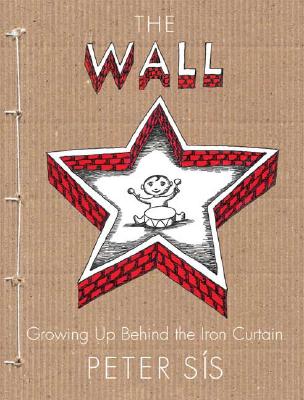
The Wall: Growing Up Behind the Iron Curtain
written and illustrated by Peter Sis, 2007, New York: Farrar, Straus and Giroux Books for Young Readers. (0374347018).
Author/Illustrator Website: http://www.petersis.com/
Media: pen and ink, with water color, colored pencils and multimedia elements
Awards and Honors: American Library Association Best Books for Young Adults; American Library Association Notable Children's Books; Caldecott Honor Book; IRA Notable Books for a Global Society; Boston Globe - Horn Book Award; New York Times Book Review Best Illustrated Books of the Year; Orbis Pictus; Amazon.com Top 10 Editors’ Picks: Children; Bank Street Best Children's Book of the Year; CCBC Choice (Univ. of WI); Children's Books: 100 Titles for Reading and Sharing, New York Public Library; Eisner Award Nominee; Parents' Choice Award Winner; NCSS-CBC Notable Trade Book in the Field of Social Studies; Booklinks Lasting Connection; Booklist Editors' Choice; Booklist Top 10 Biographies for Youth; Bulletin of the Center for Children’s Books Blue Ribbon Award; Horn Book Magazine Fanfare List; Kirkus Reviews Editor's Choice; Publishers Weekly Best Children's Books of the Year; School Library Journal Best Books of the Year; VOYA's Nonfiction Honor List; Robert F. Sibert Award - Medal; Capitol Choices Noteworthy Titles for Children and Teens; Illinois Read for a Lifetime Award Master List; Michigan Great Lakes Great Books Award Master List; New Mexico Battle of the Books Master List; North Dakota Flicker Tale Children's Award Master List; Utah Beehive Book Award Master List; Book Links; Booklist; Booklist, Starred; Top 10 Biographies for Youth; Boston Globe; Bulletin-Center Child Books, Starred; Horn Book, Starred Review; Kirkus Reviews, Starred Review; Los Angeles Times; New York Times Book Review; Publishers Weekly, Starred; San Francisco Chronicle; School Library Journal, Starred Review; USA Today; VOYA (Voice of Youth Advocates)
Annotation: Peter Sis' illustrated memoir of what life was like growing up behind the Iron Curtain.
Personal Reaction/ Discussion of Artwork:
Peter Sis was born in Czechoslovakia after World War II and grew up in Prague during the Cold War. This book is his attempt to explain to his children his life before he came to America. In The Wall, we hear his story, which is the story of many others who grew up under totalitarianism yet yearned to be free. An artist from a very young age, Sis felt the restrictions of Communist rule acutely. He tells of his childhood and adolescence- happy but never free of the ever-present influence of Communism. Russian language classes, public displays of loyalty and participation in the Communist youth movement are all compulsory activities for young Sis and his classmates. Initially he doesn't question the system, but as he gets older bits of Western news and media start to slip through the Iron Curtain. With this new information young people begin to question the old ways of doing things. In 1968, as Peter is entering young adulthood, Alexander Dubcek begins to ease the government's strict censorship policies and Peter's dream of freedom starts to seem possible. Art, travel, poetry, music, film and theater are burgeoning and Peter sees these methods of self-expression as ways to be free. Out of fear of losing control, the State soon cracks down on expression. Sis describes the fear and intimidation that ensues as dissidents are jailed, monitored, deported and tortured. Even under the intense oppression Peter continues to create and dares to dream of freedom. Peter leaves the Soviet Union in 1984 to go to the United States for work and doesn't return.
Through a combination of words, pictures, diary entries and scrap book style collages, Sis tells his story. Sis' cartoon-like drawings are deceptively simple. He uses multiple frames on most pages to show scenes of life in Soviet Prague. Color is symbolic in his illustrations. Scenes of life in the Soviet Union are rendered starkly in black and white pen drawings with brash dashes of red. Sis uses accents of full color to represent freedom. Peter's own drawings and other forms of self-expression, as well as all references to Western pop culture appear as bright, colorful spots in a sea of monochrome.
The Wall is a wondeful introduction to a complex and often confusing piece of history for children. Sis shares his personal experience in easily relatable language and images. Upper elementary students will gain from this book a better understanding of what life was like for children growing up in the Soviet Union.
Curriculum Connection: Upper Elementary or Middle School, Social Studies, Cold War
Lesson Plan:
Subject Area:
History
Suggested Grade Level:
6-8
Lesson Title:
Growing Up During the Cold War: Us vs. Them (adapted from http://www.the-best-childrens-books.org/The-Wall-Sis-ideas.html)
Time:
3-4 hours
Materials/Equipment Required:
-The Wall by Peter Sis
-timelines (http://www.the-best-childrens-books.org/The-Wall-timeline.html)
- pencils
Objectives:
Students will familiarize themselves with events in history during the Cold War and compare and contrast the contrasts of lifestyles for people on either side of the Iron Curtain.
Suggested Procedure:
1. Students will carefully read The Wall by Peter Sis.
2. Give the students the timelines and as a class brainstorm events that happened in the author’s life during the time and events that happened in the Soviet Union at that time
3. Students will then choose the 20 best for each category and on the top half of the paper (above the big black timeline bar), write:
- above the thin black top line--10 events that took place in the author's life at that time
- below the thin black top line--10 events that took place in the Soviet region at that time
4. Once the top part is done, for homework have the student interview someone they know (neighbor, grandparent...) who was born in the US in the 1940s or 1950s, asking him or her for memories of what they were doing during each era and memories of what was happening in the United State during that time. Encourage the student to ask questions of the interviewee to see if he or she felt the same way about living in the United States that the author did about living in the Soviet realm. (ie: "Did you feel free to listen to whatever music you wanted?", “Did you feel free to travel?”)
5. On the bottom half of the paper (below the big black timeline bar), write:
- above the thin black bottom line--10 events that took place in the United States at that time
- below the thin black bottom line--10 events that took place in the person's life at that time
6. As a class, share the work that each student did. Discuss similarities and differences among the results of the interviews (people growing up in the US) and similarities and differences between people growing up in the US and the Soviet Union.
Labels:
artwork,
curriculum connection,
lesson plan
Saturday, July 23, 2011
A River of Words: The Story of William Carlos Williams
by Jen Bryant, illustrated by Melissa Sweet, 2008. Grand Rapids, MI: Eerdmans Books for Young Readers. (9780802853028).
Author Website: http://www.jenbryant.com/
Illustrator Website: http://melissasweet.net/
Awards and Honors: About.com- Best Children's Books of 2008; Book Links- Lasting Connections of 2008; Caldecott Honor Book, 2009; Christian Science Monitor- Best Children's Books of 2008; CLN Chapter & Verse Book Club Selection; Cooperative Children's Book Center- Charlotte Zolotow Honor Award, 2009; Cybils Award Finalist, 2008; Junior Library Guild Selection; Kirkus Reviews- Best Children's Books of 2008; NCTE Notable Children's Books in the Language Arts, 2009; NCTE Orbis Pictus Award, 2009; New York Times Book Review- Best Illustrated Children's Books of 2008; Parents' Choice Award Recommended winner, 2008; School Library Journal Best Books, 2008.
Media: watercolor, collage and mixed media
Annotation: A visually stunning biography of physician and poet, William Carlos Williams.
Personal Reaction/ Discussion of Artwork:
When I was younger
it was plain to me
I must make something of myself.
- William Carlos Williams,
"Pastoral"
Jen Bryant begins her picture biography of the poet, William Carlos Williams, with this quote taken from his own verse. While enamored with words, Williams felt obligated to "make something" of himself and followed his duty to seek a profession. Though Williams is perhaps best known for his contributions to modern American poetry, he was also a doctor who delivered an estimated 3,000 babies during his career. Bryant tells the story of how William Carlos Williams served the community as a doctor, while still pursuing his passion for poetry.
Bryant focuses on Williams' childhood, his love for nature and its rhythms, and his love of poetry and art. Bryant's prose is simple and lyrical, echoing Williams' own verse. Often her words even look like the lines of a poem:
"I have never seen a swan or an archer," Willie thought.
"I want to write about ordinary things-
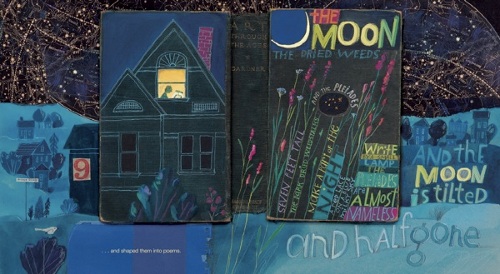
plums, wheelbarrows, and weeds,This is also a visually beautifully book. Melissa Sweet's brightly colored, richly textured and layered collages provide a depth to this book that invites multiple re-readings. Upon examining the illustrations, we see Sweet has incorporated stationery, notebooks and even pages of medical books into her collages. Additionally, Sweet adds even more depth by working in to her collages Williams' own poems. In the spread pictured above, Sweet has turned Williams' poem "The Descent of Winter" into a gorgeous nighttime scene. We can see Williams' silhouette in the upstairs window of his home. The lines of the poem are spread out over the pages and Sweet has beautifully depicted the images of the poem: the moon, the dried weeds and the Pleiades. The collaged book covers and starcharts combined with Sweet's color palette of rich blues creates a lovely, evocative effect.
fire engines, children, and trees-
things I see when I walk down my street
or look out my window."
Curriculum Connection: 6th grade- Language Arts/poetry
Labels:
artwork,
biography,
Caldecott Honor,
curriculum connection,
poetry
Monday, July 18, 2011
ellington was not a street
by Ntozake Shange, illustrated by Kadir Nelson, 2004. New York: Simon & Schuster Books for Young Readers. (0689828845).
Author Website: http://www.ntozakeshange.org/home.html
Illustrator Website: http://www.kadirnelson.com/
Media: oil
Awards and Honors: ALA Coretta Scott King Award for Illustration , ALA Notable Children's Books , Capitol Choices List (DC), CCBC Choices (Cooperative Children's Book Council), Chicago Public Library's Best of the Best , Coretta Scott King Award, Kansas State Reading Circle Primary Titles, NAACP Image Award Nominee, NCTE Notable Children's Books in the Language Arts, NYPL 100 Titles for Reading and Sharing, Once Upon a World Award (Simon Wiesenthal Center & Museum of Tolerance), Parents' Choice Award
Annotation: A personal tribute to poet Ntozake Shange's childhood home and the influential men who gathered there.
Personal Reaction/ Discussion of Artwork:
Poet Ntozake Shange's childhood home was frequented by some of the most influential African Americans of the 20th century. From W.E.B. DuBois, to "Dizzy" Gillespie, Paul Robeson and the eponymous Duke Ellington, these "men/ who changed the world" are remembered in Shange's poem and expressively depicted in Kadir Nelson's oil illustrations.
If Shange's poem comes off a bit solemn- as an ode to what used to be and now is "mere memory", Nelson's illustrations are a celebration. His portraits are beautifully rendered in oil with special attention given to the features and expressions of his subjects. We see this extraordinary group of men sing, mingle and converse (about exactly what, we are left to imagine, but we can infer they are likely matters of significance). Nelson's oil illustrations are rich with color and detail. On the cover of ellington was not a street the author appears as a pig-tailed young child of seven or eight, holding an LP copy of Duke Ellington's "Mood Indigo"- the song from which the title of Shange's original poem is taken. Opposite the title page the author appears again, this time as a teenager seated on a piano bench while holding the same record. Observant readers will notice on the first page of the book that the woman on Ellington Street with the red umbrella is also, in fact, our narrator. Within the body of the poem, Shange is depicted as a very young child, perhaps two or three years old at the most, dwarfed by the musicians, politicians and activists who visit her home. Other reviewers have pointed out that the age of the narrator in the bulk of the illustrations is at odds with the age of the intended audience of the book. Nelson takes artistic liberties here; by depicting Shange as a tiny child, the men are transformed into grand and imposing figures- literally as well as figuratively.
Curriculum Connection: Middle School- Language Arts/ poetry
Thursday, July 14, 2011
Blockhead: The Life of Fibonacci
by Joseph D'Agnese, illustrated by John O'Brien, 2010. New York: Henry Holt and Company. (9780805063059).
Media: pen and watercolor
Author Website: http://www.josephdagnese.com/Welcome.html
Illustrator Website: none
Awards and Honors: Best 2010 Science Books for Kids — Smithsonian Magazine, Best Children’s Books of the Year — Bank Street College, Noteworthy Books for Children and Teens — Capitol Choices, 2011 ALSC Notable Nominee, Best Books for 2010 — Children’s Book Compass
Annotation:
Leonardo Fibonacci is considered one of the greatest Western
mathematicians, but it wasn't always this way. When he was a kid he
daydreamed about numbers so much that people called him "Blockhead", until he learned that there's nothing stupid about following your passion.
Personal Reaction:
Leonardo loves numbers and he thinks about them day and night. He daydreams about numbers so much that people begin calling him "Blockhead". Leonardo tries to ignore them and follows the advice of a friend who tells him, "... learn all you can about numbers. That way you will always be happy". This is a story not only about the mathematician known as Leonardo Fibonacci, but also about following your passion regardless of what other people think
Even though Fibonacci lived almost 900 years ago, Joseph D'Agnese's first-person narrative style makes the story accessible for children and relatable enough that it seems as if it could have happened yesterday. D'Agnese takes what little is known about Fibonacci's life and skillfully pieces it together with a bit of imagination to fortify the tale. It's a kid friendly story filled with dashes of humor- when Leonardo's portly friend encourages him to follow his dreams, he says matter-of-factly, "I think people are happiest when the know what pleases them. Me, I love cheese". In another scene, Leonardo visits the palace of the Holy Roman Emperor who challenges him to solve "a bunch of really hard math problems". When Leonardo quickly completes the problems the Emperor calls Leonardo "one smart cookie". O'Brien's cheerful illustrations are filled with nautilus shells, sunflowers and ferns- all references to Fibonacci's famous pattern.
Even if you are unfamiliar with Fibonacci and his famous numbers, Blockhead is well-crafted enough to enjoy simply on its own merits. This books would make an excellent addition to an upper elementary school classroom or library.
Curriculum Connection: 5th grade, math.
Labels:
2010/2011,
biography,
curriculum connection,
non-fiction
Tuesday, July 12, 2011
Ben and the Emancipation Proclamation
by Pat Sherman, illustrated by Floyd Cooper, 2010. Grand Rapids, Michigan: Eerdmans Books for Young Readers. (9780802853196).
Author Website: none
Illustrator Website: http://www.floydcooper.com/
Media: oil wash on board
Awards and Honors: none
Annotation: The true story of Ben, a young slave who teaches himself to read in a time when literacy was forbidden for African Americans. His ability to read proves important to others when President Lincoln issues the Emancipation Proclamation.
Personal Reaction: Author Pat Sherman and Coretta Scott King Award winning illustrator, Floyd Cooper tell the touching true story of Benjamin Holmes, a young slave living during the Civil War who teaches himself to read. Ben's father teaches him the alphabet before he is sold and when Ben is apprenticed to a tailor in Charleston he practices reading while running errands for his boss. Ben reads street signs, shopping lists and even bits of discarded newspaper.
Ben knows to hide the fact that he can read and write- it's dangerous for a slave to be educated and he has to be very careful. But he is not able to hide his reading and writing from the other slaves for long. Word gets around and wherever Ben's errands take him slaves implore Ben to teach them to read and write. Before long the Union Army pushes closer towards Charleston and Ben's employer flees, leaving Ben in a slave prison. Weeks pass while Ben and his fellow prisoners are cut off from any news of the War. One night the prisoners bribe a guard to get the latest copy of the Charleston Mercury and ask Ben to read the message from Abraham Lincoln that is printed inside- the Emancipation Proclamation. The author's note tells readers that Ben did not immediately gain his freedom but ended up working in several businesses. He eventually enrolled in Nashville's Fisk University, traveled internationally with Fisk's chorus and taught in a rural school before dying of tuberculosis sometime during the 1870s.
The story is a testament to the power of the written word and the liberating force of education. Pat Sherman has done a wonderful job of telling Ben's story so that it is powerfully moving without being sentimental or saccharine. Floyd Cooper's expressive and sensitively rendered illustrations pair well with Sherman's prose. Ben and the Emancipation Proclamation would make an excellent book to use with elementary aged children in lessons on slavery and the Civil War.
Curriculum Connection: 4th Grade, Civil War, Emancipation Proclamation
Labels:
2010/2011,
biography,
curriculum connection
Sunday, July 10, 2011
Dark Emperor & Other Poems of the Night
by Joyce Sidman, illustrated by Rick Allen, 2010. New York: Houghton Mifflin Books for Children. (9780547152288).
Author Website: http://www.joycesidman.com/
Illustrator Website: http://www.beckieprange.com/
Media: relief prints, handcolored with gouache
Awards and Honors: Newbery Honor Book, 2011; CCBC Choices, 2011; NCTE Notable Children's Trade Book, 2011; New York Times Bestseller, 2011; ALA Notable Children's Book, 2011; Horn Book Fanfare Selection, 2011; Kirkus Reviews Best Books of the Year, 2010; Bulletin Blue Ribbon Book, 2010; Lee Bennett Hopkins Poetry Award Honor Book; Boston Globe/Horn Book Award Honor Book; Cybils Poetry Award Finalist; Booklist Editor's Choice; CBC Bank Street Best Book of the Year (starred); Chicago Public Library Best book of the Year; NSTA-CBC Outstanding Science Trade Book
Annotation: Joyce Sidman's poems explore the bustling, buzzing nocturnal forest and shed light on the woodland creatures who inhabit the night.
Personal Reaction: A beautiful and ingenious blend of non-fiction book and poetry collection. Sidman's poems are haunting and evocative, imbuing the nighttime forest with a beguiling enchantment. These poems are a sensory feast and emphasize the smells, sounds and feelings of the night, accentuating the importance of all the senses for nocturnal animals who don't rely primarily on vision:
"Come feel the cool and shadowed breeze,Each spread highlights one denizen of the night forest through a poem accompanied by an informational sidebar. Sidman often writes these poems in first person, using the animals or plants as narrator. Her factual sidebars provide the reader with additional information that expounds upon the poems. "Cricket Speaks" is narrated by a cricket eager for the "trilling hour" to come so that he can "sing, sing, till the branches tremble" (p. 20). The sidebar teaches readers that a cricket's trill is called stridulation and female crickets will pick a mate based on the strength of his song. Sidman provides a glossary at the back of the book for words and concepts with which children may be unfamiliar.
come smell your way along the trees,
come touch rough bark and leathered leaves:
Welcome to the night." (p.6)
Allen's illustrations, gouache colored linoleum prints, are beautifully textured and rich with detail. Double spread, full bleed illustrations at the beginning and end of the book act as wordless opening and closing scenes; one depicts the sun setting and an owl- the eponymous "Dark Emperor"- taking wing, the next shows the sun rising and the owl roosting in the tree tops.
Use of Onomatopoeia: (p. 6) "To all of you who crawl and creep,/ who buzz and chirp and hoot and peep."
(p. 12) "What symphonies of/ squeaks and skitters, darts/ and rustles, swell the vast,/ breathing darkness of your realm?"
(p. 18) "We mew and coo a soft duet."
Use of simile: (p.22) "Like noses pink/ in midnight air,/ like giants' ears,/ like elfin hair,/ like ancient cities/ built on cliffs,/ the mushrooms come,/ the mushrooms come."
Curriculum Connection: 3rd grade, science- nocturnal/diurnal animals, language arts, poetry
Labels:
2010/2011,
curriculum connection,
newbery honor,
poetry
Friday, July 8, 2011
Can We Save the Tiger?
written by Martin Jenkins and illustrated by Vicky White, 2011, Somerville, Massachusetts : Candlewick Press. (0763649090).
Media: pencil and oil paint
Author Website: none
Illustrator Website: none
Awards and Honors: none
Annotation: Discusses endangered species and the role humans can play in threatening as well as rehabilitating their populations.
Personal Reaction: Jenkins and White have created a very special book with Can We Save the Tiger?. Sensitive and balanced without being preachy, Can We Save the Tiger? introduces children to well-known endangered species such as the tiger, but also makes a point of teaching about other less cuddly endangered animals like the Indian vulture and the Partula snail. I like that Jenkins not only discusses endangered animals, but also teaches children about animals like the bison and the rhinocerous, that were once endangered but through the actions of humans have been brought back from the brink of extinction. He also avoids condemning humans, explaining that sometimes the actions of people trying to house themselves and produce the things they need have resulted in harming animals:
Curriculum Connection:
Elementary School biology
Lesson Plan:
Subject Area:
Biology
Suggested Grade Level:
4-5
Lesson Title:
Causes of Extinction (adapted from Scholastic’s website: http://www2.scholastic.com/browse/lessonplan.jsp?id=391)
Time:
1-2 hours
Materials/Equipment Required:
-Can We Save the Tiger? By Jenkins and White
Objectives:
There are five major causes of extinction: habitat loss, an introduced species, pollution, population growth, and overconsumption. Through the activity, students will create a list of reasons why animals can become extinct and learn the acronym HIPPO as a way of remembering causes of extinction.
Suggested Procedure:
Author Website: none
Illustrator Website: none
Awards and Honors: none
Annotation: Discusses endangered species and the role humans can play in threatening as well as rehabilitating their populations.
Personal Reaction: Jenkins and White have created a very special book with Can We Save the Tiger?. Sensitive and balanced without being preachy, Can We Save the Tiger? introduces children to well-known endangered species such as the tiger, but also makes a point of teaching about other less cuddly endangered animals like the Indian vulture and the Partula snail. I like that Jenkins not only discusses endangered animals, but also teaches children about animals like the bison and the rhinocerous, that were once endangered but through the actions of humans have been brought back from the brink of extinction. He also avoids condemning humans, explaining that sometimes the actions of people trying to house themselves and produce the things they need have resulted in harming animals:
"So if you were a poor farmer trying to make a living with a couple of cows and a few goats, you might not be too happy if you found out there was a hungry tiger living nearby. And if you knew that someone might pay you more for a tiger skin and some bones than you could earn in three whole months working the fields, then you might find it very tempting to set a trap or two, even if you knew it was against the law".Jenkins' prose is warm and conversational and Vicky White's beautiful, delicately detailed illustrations really make the book. Using pencil and occasionally oil paints, she imbues each animal with a lifelike realism. Her animals, whether feathered, furry, scaly or slimy, are richly textured and seem to almost leap from the page. All in all, Can We Save the Tiger? is a wonderful, sensitive introduction to endangered animals for elementary aged children.
Curriculum Connection:
Elementary School biology
Lesson Plan:
Subject Area:
Biology
Suggested Grade Level:
4-5
Lesson Title:
Causes of Extinction (adapted from Scholastic’s website: http://www2.scholastic.com/browse/lessonplan.jsp?id=391)
Time:
1-2 hours
Materials/Equipment Required:
-Can We Save the Tiger? By Jenkins and White
Objectives:
There are five major causes of extinction: habitat loss, an introduced species, pollution, population growth, and overconsumption. Through the activity, students will create a list of reasons why animals can become extinct and learn the acronym HIPPO as a way of remembering causes of extinction.
Suggested Procedure:
1. Teacher will read aloud Can We Save the Tiger? to the class.
2. Teacher will create scenario cards for each of the below causes of extinction. Multiple examples of each cause will be needed. An example: A species of bird lived in wetlands until trash and chemicals made them sick (pollution), A species of fish lived in streams and rivers until a new, invasive species of fish came and started eating them (introduced species)
3. Write this acronym on the board and discuss each cause:
H- Habitat loss
I - Introduced species
P- Pollution
P- Population growth
O- Overconsumption
4. Read the scenario cards and have students give the cause (habitat loss, introduced species, pollution, population growth, overconsumption) behind each scenario.
Labels:
2010/2011,
curriculum connection,
lesson plan,
non-fiction
Coolies
Coolies
by Yin, illustrated by Chris Soentpiet, New York: Philomel Books, 2001. (0-39923227-3).
Author website: http://www.soentpiet.com/yins_corner.html
Illustrator website: http://www.soentpiet.com/
Media: watercolor on watercolor paper
Annotation: Shek and his little brother Wang travel from a revolution scarred China to a burgeoning America and begin working on the western span of the Transcontinental Railroad.
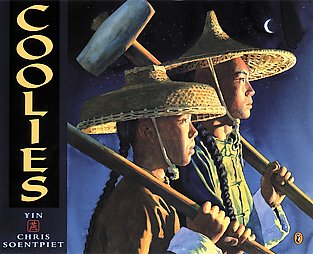
Personal Reaction: The story exposes the harsh working and living conditions of the Chinese railroad workers in America and touches on their perseverance and determination to make a better living, even in the face of social prejudice and injustice. Students are introduced to non-European immigrant players who took stake in the formation of the current day United States. The building of the trans-continental railroad introduces important lessons on the immigrant experience, unequal treatment by labor bosses to Irish and Chinese workers, and the struggle for fair labor practices. Soentpiet's art is wonderful, with expressive faces on each page that offer a powerful humanity that jumps out of each picture, while large scale background action gives the reader a great understanding of the tasks accomplished from railroad work in scorching desserts to freezing mountain blizzards. The book works as a tale of survival and of familial connection as well as a historical lesson on this important chapter of American history.
Annotation: Shek and his little brother Wang travel from a revolution scarred China to a burgeoning America and begin working on the western span of the Transcontinental Railroad.
Personal Reaction: The story exposes the harsh working and living conditions of the Chinese railroad workers in America and touches on their perseverance and determination to make a better living, even in the face of social prejudice and injustice. Students are introduced to non-European immigrant players who took stake in the formation of the current day United States. The building of the trans-continental railroad introduces important lessons on the immigrant experience, unequal treatment by labor bosses to Irish and Chinese workers, and the struggle for fair labor practices. Soentpiet's art is wonderful, with expressive faces on each page that offer a powerful humanity that jumps out of each picture, while large scale background action gives the reader a great understanding of the tasks accomplished from railroad work in scorching desserts to freezing mountain blizzards. The book works as a tale of survival and of familial connection as well as a historical lesson on this important chapter of American history.
Curricular Connection:
Manifest Destiny and Westward Expansion; Transcontinental Railroad; the immigrant experience / Social Science, Grade 5: Students will analyze new waves of immigration to the U.S. and its effect on the cultural and physical landscape.
Unite or Die: How Thirteen States Became a Nation
by Jacqueline Jules, illustrated by Jef Czekaj, Watertown, MA: Charlesbridge, 2009. (978-1-58089-189-9).
Author website: http://www.jacquelinejules.com
Illustrator website: http://www.czekaj.com
Media: Ink on Bristol and then scanned and colored on an Apple iBook using Adope Photoshop 6.0
Awards and Honors: 2010 Annual Whitney & Scott Cardozo Award for Children’s Literature;
Listed on New York Public Library Recommended Reading List, 2009.
Annotation: With a style described as reader’s theater, this book presents a dramatic reenactment of how and why the United States Constitution came to be with humor, energy, and personality.
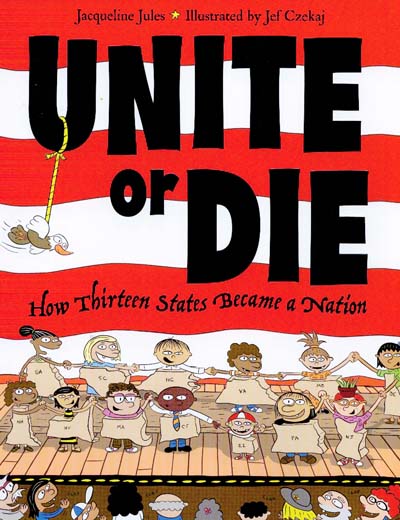
Personal Reaction: The challenges the thirteen colonies faced after the American Revolution, particularly in the creation of the United States Constitution, are highlighted in this playful, entertaining story which showcases a group of elementary students performing a reenactment of the conflicts and compromises of the time: each performer represents a new state’s interests and concerns. Author Jacqueline Jules’ style appeals to students of all ages in that half of the story is told through traditional, narrative text while the other half is represented by the conversation bubbles of the students (in their own language). Illustrator Jef Czekaj’s cartoon drawings of the student’s performing their stage “state” roles enhances the text and brings the performance to life in a believable way. The pacing is quick as the reader jumps from conversation bubbles and different student’s arguments for their state’s cause while the bright, silly cartoons renew interest and relate to young readers in what can often be a stale, disconnected subject for students.
Jules begins the book with the end of the American Revolution, showing how the thirteen new states act independently of each other and the problems that arise because of this. When the states agree to work together for a solution (and a more united government), readers are met with an onslaught of new problems as to how much work goes into the creation of the Constitution—or rather, how many arguments and disagreements the states have for different solutions. By the time a final compromise is made and the U.S. Constitution is signed, readers will understand how and why America’s government was created to balance power between three branches.
An afterword provides a more “textbook” discussion of the creation of the Constitution and the following five pages of “Notes” reference specific pages in the book before highlighting important historical aspects that were presented in that section, such as “Who owned Vermont?” and “How did Roger Sherman save the day?” These references add further depth to the story itself and to the events that took place leading up to, and during, the creation of the U.S. Constitution. Jules also provides a lengthy bibliography that students can use for further reading and research.
The interactive style of this book comes from the idea of “reader theater,” where teaches can use their students as characters. The style of the book—where the characters are already putting on a play of their own—sets students up for successful adoption of this book for a live performance, truly bringing history to life and into the classroom. The cartoon art of Czekaj connects to the young reader’s interests and personal preference of media styles while Jules’ conversation bubbles move the story along in a relatable, engaging way. The narration text provides a foundation for the students’ performances and are written as clear, simple descriptions that set up the current page’s scene. Jules’ and Czekaj’s fun, pop-culture storytelling style make history appealing, not scary, to readers and provide a creative platform as for how students can learn about the creation of the U.S. Constitution.
Jules begins the book with the end of the American Revolution, showing how the thirteen new states act independently of each other and the problems that arise because of this. When the states agree to work together for a solution (and a more united government), readers are met with an onslaught of new problems as to how much work goes into the creation of the Constitution—or rather, how many arguments and disagreements the states have for different solutions. By the time a final compromise is made and the U.S. Constitution is signed, readers will understand how and why America’s government was created to balance power between three branches.
An afterword provides a more “textbook” discussion of the creation of the Constitution and the following five pages of “Notes” reference specific pages in the book before highlighting important historical aspects that were presented in that section, such as “Who owned Vermont?” and “How did Roger Sherman save the day?” These references add further depth to the story itself and to the events that took place leading up to, and during, the creation of the U.S. Constitution. Jules also provides a lengthy bibliography that students can use for further reading and research.
The interactive style of this book comes from the idea of “reader theater,” where teaches can use their students as characters. The style of the book—where the characters are already putting on a play of their own—sets students up for successful adoption of this book for a live performance, truly bringing history to life and into the classroom. The cartoon art of Czekaj connects to the young reader’s interests and personal preference of media styles while Jules’ conversation bubbles move the story along in a relatable, engaging way. The narration text provides a foundation for the students’ performances and are written as clear, simple descriptions that set up the current page’s scene. Jules’ and Czekaj’s fun, pop-culture storytelling style make history appealing, not scary, to readers and provide a creative platform as for how students can learn about the creation of the U.S. Constitution.
California History / Social Science, Grade 5, California Standard: 5.7: Students describe the people and events involved in the development of the U.S. Constitution and the impact and consequences of the document for the new nation.
The Revolutionary John Adams
written and illustrated by Cheryl Harness, Washington, D.C: National Geographic, 2003. (0-7922-6970-5).
Awards: Beacon of Freedom Award, Nominee, 2006.
Author Website: None
Media: Rich watercolors on paper.
Annotation: Harness traces the life of President John Adams from his humble beginnings on a farm to the White House. This biography offers details of Adams’ work as a revolutionary, politician, lawyer, statesman and leader.
Personal Reaction: This biography is steeped in facts, but it is also a very personal story of a man’s life. The author traces John Adams’ life from his birth on a farm in New England to his death on a farm not far away. In between, the reader learns about the role of Adams in revolting against England, building the government of new nation, working side by side with Washington, Jefferson and Franklin, serving as Vice-President and President, as well as working as a statesman abroad. The numerous quotes from Adams, familial details and excerpts from personal letters to his beloved wife Abigail allow for an insight into Adams life that makes this biography more memorable than others. Harness uses sweeping watercolor paintings of people and maps to bring Adams’ time to life. In just 40 pages, Harness not only tells Adams’ story, but the history of our emerging and young nation. The personal perspective and illustrations provide an accessible history lesson for students in grades five to seven.
Use of Simile: (p.31) “news that plunked like a round black stone into the world of John and Abigail Adams.”
Use of Metaphor: (p.5) “stomach full of butterflies.” (p.26) “dug deep into his bag of political skills.” (p.29) “Two old lions, France and England.”
Use of Alliteration: (p.16) “soldiers froze and failed.” (p.24) “diamond-decked Marie Antoinette.” (p.32) “stump-stubbled Pennsylvania Avenue.”
Use of Onomatopoeia: (p.6) “John Adams fizzed with total and complete happiness.” (p.8) “People began to grumble.” (p.11) “plunk . . .plunk . . .plunked boxes of tea into Boston Harbor.”
Use of Sophisticated Language: (p. 26) “coaxed out of Holland official recognition and loans, lifeblood for his nation.”
Curricular Connection: California History / Social Science, Grade 5, California Standards: 5.6: Students understand the course and consequences of the American Revolution. 5.7: Students describe the people and events associated with the development of the U.S. Constitution and analyze the Constitution’s significance as the foundation of the American republic.
Paul Revere's Midnight Ride
by Stephen Krensky, illustrated by Greg Harlin, 2002, New York, NY: Harper Collins Publisher. (0-688-16410-2).
Author website: http://www.stephenkrensky.com/
Illustrator website: "no author website"
Media: watercolor and pencil
Annotation: Paul Revere was a known messenger for the colonial rebels. On the night British troops planned to seize a stockpile of colonist ammunition, Paul Revere sets off on his midnight ride to warn his friends in Concord.
Personal Reaction: Paul Revere’s Midnight Ride touches all the right notes of an engaging and exciting picture book. It’s an adventure story that has chases, armies and hiding rebels risking their lives for causes they believe in. The story is involving and detailed, teaching little known facts about this famous night ride. I re-learned after reading the story that Revere was warning his fellow colonists of a British plot to seize ammunitions stockpiled by the citizen militia. I didn’t recall that the journey was 19 miles long, from Boston to Concord, and I don’t know if I ever learned that Revere never made it to Concord himself. He was almost captured, just passed Lexington, and had his horse confiscated by the British. He walked home at the end of that famous night. Author Krensky fills the tale with lots of important facts that flesh out the story.
The watercolor illustrations by Harlin really set the mood of the story, each page muted with dark colors that seem to take place at night, as does most of the story. Each page is deep with shadows and is given an aged look, leaving the impression that we’re seeing events from a long time ago. I appreciated the work that went into Paul Revere’s Midnight Ride for it refreshed my knowledge of this important event in the birth of our nation.
Annotation: Paul Revere was a known messenger for the colonial rebels. On the night British troops planned to seize a stockpile of colonist ammunition, Paul Revere sets off on his midnight ride to warn his friends in Concord.
Personal Reaction: Paul Revere’s Midnight Ride touches all the right notes of an engaging and exciting picture book. It’s an adventure story that has chases, armies and hiding rebels risking their lives for causes they believe in. The story is involving and detailed, teaching little known facts about this famous night ride. I re-learned after reading the story that Revere was warning his fellow colonists of a British plot to seize ammunitions stockpiled by the citizen militia. I didn’t recall that the journey was 19 miles long, from Boston to Concord, and I don’t know if I ever learned that Revere never made it to Concord himself. He was almost captured, just passed Lexington, and had his horse confiscated by the British. He walked home at the end of that famous night. Author Krensky fills the tale with lots of important facts that flesh out the story.
The watercolor illustrations by Harlin really set the mood of the story, each page muted with dark colors that seem to take place at night, as does most of the story. Each page is deep with shadows and is given an aged look, leaving the impression that we’re seeing events from a long time ago. I appreciated the work that went into Paul Revere’s Midnight Ride for it refreshed my knowledge of this important event in the birth of our nation.
Life in New England; Taxation of colonies; The road to war; The American Revolution / Social Science, Grade 5: Students will consider life in the colonies and the buildup to the American Revolution.
Subscribe to:
Posts (Atom)