Showing posts with label 2010/2011. Show all posts

Tuesday, February 14, 2012

Pete The Cat: I Love My White Shoes


Pete the Cat: I Love My White Shoes
by Eric Litwin, illustrated by James Dean. 2010. New York: HarperCollins. Unpaged. (9780061906220)

Author Website: http://www.ericlitwin.com/

Illustrator Website: none

Media: watercolor

Awards and Honors: none

Audience: Preschoolers

Annotation:
Pete the Cat always keeps his cool- no matter what obstacles life presents.

Personal Reaction:
Pete the Cat is a lovable, laid back cat who loves his shoes.

Saturday, February 4, 2012

Press Here


Press Here
written and illustrated by Herve Tullet. 2010. San Francisco: Chronicle Books. Unpaged. (9780811879545)

Author/Illustrator Website: http://www.herve-tullet.com/en/accueil.html

Media: acrylic paint

Awards and Honors:
New York Times Bestseller, National Indie Bestseller, Publishers Weekly Bestseller, ALA Notable Children's Book nominee, A Publishers Weekly "Best Book of the Year", A Kirkus Reviews "Best Children's Book of the Year"

Audience: all

Annotation:
Readers control the action in this deceptively simple, completely interactive, utterly engrossing picture book.

Personal Reaction:
    Press Here is a work of simple brilliance; a picture book that the reader controls, one that functions as a kind of analog app. 

    When I read this book to a group of children at storytime, you would have thought I was doing magic. The children were electrified by each turn of the page; I have never seen children react to a book with so much excitement and awe.

    There's nothing complicated in the premise and Tullet's illustrations in Press Here couldn't be simpler: yellow, red and blue dots on a white or black background. On each page readers are invited to interact with the book by pressing a dot, tilting or shaking the book, or clapping; and in doing so they make the dots move. It's a simple idea, but the way that these dots change color, become larger and smaller, and dance against the backgrounds is completely magical. This book's immediate appeal and simple joy make it destined to become a classic.

Wednesday, October 12, 2011

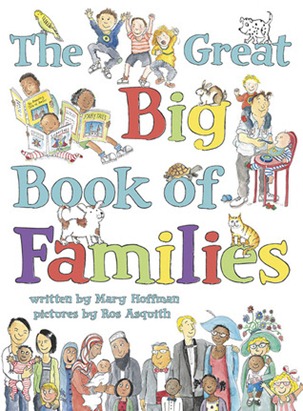
The Great Big Book of Families


The Great Big Book of Families
by Mary Hoffman, illustrated by Ros Asquith. 2010. New York: Dial Books for Young Readers. Unpaged. (9780803735163)

Author Website: www.maryhoffman.co.uk/

Illustrator Website: www.rosasquith.co.uk/

Media: pen and watercolor

Awards and Honors: none

Audience: Preschoolers

Annotation:
A sweet little book that celebrates the diversity among (and within) families.

Personal Reaction:
Families come in all shapes, sizes and forms. Mary Hoffman's book provides a sweet introduction to families and all their iterations for pre-school to second grade children. Hoffman describes all types of families in a gentle, non-judgmental way. She takes pains to be inclusive, but the book steers clear of preaching. It's a nice way to start a conversation with children about all the different ways to be a family. Ros Asquith's busy and colorful cartoon-like illustrations will grab children's attention and allow the book to stand up to repeated readings as kids seek out new details on each page.

Saturday, August 6, 2011

The Extraordinary Mark Twain (According to Susy)


The Extraordinary Mark Twain (According to Susy)
by Barbara Kerley, illustrated by Edwin Fotheringham. 2010. New York: Scholastic Press. (9780545125086).

Author Website: http://www.barbarakerley.com/Site/Welcome.html

Illustrator Website: http://www.edfotheringham.com/

Media: digital media

Awards and Honors: A Junior Library Guild Selection; Kirkus, starred review; School Library Journal, starred review; Publishers Weekly, starred review

Annotation:
Much ink has been spilled writing about Samuel Langhorne Clemens, the man the world knows as Mark Twain, but did you know that his closest biographer was Susy Clemens, his young daughter?

Personal Reaction:
      The Extraordinary Mark Twain (According to Susy) is an illuminating look at Mark Twain, the husband and father. Written from anecdotes compiled by Susy Clemens, Twain's young daughter, it offers entertaining, personal observations on the man that many thought they understood, but few really knew. Susy, determined to "set the record straight" on her "Papa", wrote a revealing biography of him in her own diary and Kerley uses actual excerpts in the book. These are included as neat journal inserts in flowy handwriting font. Fotheringham's digital illustrations are sometimes flat looking, as digital drawing are often wont to be, but his caricatures of Twain are expressive and spot-on. An author's note at the ends offers more details of Mark Twain, Susy and their close relationship, a timeline of Twain's life and tips on writing an extraordinary biography. 

Curriculum Connection: 
Upper Elementary/Middle School Language Arts and Social Studies

Lesson Plan:

Teacher:               
Diana Garcia

Subject Area:              
Language Arts/Social Studies      

Suggested Grade Level:      
5-7  

Lesson Title:              
Writing Biographies

Overview:              
Students will learn about biographies- what one is, how to create one- and will pair off with a classmate and create a short biography of them.

Time:                  
2-3 hours
Materials/Equipment Required:  
- The Extraordinary Mark Twain (According to Susy) by Barbara Kerley
- notebooks
- pencils

Objectives:  
Students will learn about the process of writing a biography and will practice by pairing together with a classmate, interviewing and writing a biography about them. Students will learn to research, conduct inquiries, organize and summarize information into well-written mini-biographies.
Suggested Procedure:          
Teacher will read aloud The Extraordinary Mark Twain (According to Susy) and lead a discussion of Susy and her biography of “Papa”.
Teacher will distribute the handout  “Writing an Extraordinary Biography” (available at www.barbarakerley.com/ teachers.html) to students and they will read it together and discuss how to:
1.    gather information by conducting interviews and taking notes
2.    how to get facts straight about people, places, dates, events, quotes
3.    bring the subject to life by including details, quotations, lots of examples
4.    create a well-rounded portrait of their subject by showing difficulties and successes, good and bad habits, serious and funny sides
Teacher will ask students to pair off and interview each other. Example questions are: 
-    Where were you born?
-    Who are the members of your family
-    Where do you live?
-    Who is your best friend?
-    What do you want to be when you grow up?
-    What is your best quality?
-    What is your worst habit?
-    Tell me a funny story about your family/friends?

Students will takes turns being the interviewer/subject, taking notes, etc.

Students will produce a short 1 to 2 page biography of each other.

Additional Resources:  
Allow students to explore biographies of famous people in the library, or on  biography.com or the Biography Resource Center database (if available)

Friday, August 5, 2011

Sit-In: How Four Friends Stood Up by Sitting Down


Sit-In: How Four Friends Stood Up by Sitting Down
by Andrea Davis Pinkney, illustrated by Brian Pinkney. 2010. New York: Little Brown and Company. (9780316070164). 


Illustrator Website: http://www.brianpinkney.net/

Media: watercolors and India ink on 300lb Arches paper

Awards and Honors: Carter G. Woodson Book Award, 2011; Jane Addams Book Award

Annotation: The story of how, in 1960, four college students took a stand against segregation by sitting down at a lunch counter in Greensboro, North Carolina.

Personal Reaction:
    The husband and wife team of author Andrea Davis Pinkney and illustrator Brian Pinkney have created an exceptional book in Sit-In: How Four Friends Stood Up by Sitting Down. It's lyrical, it's inspiring and it's wonderfully illustrated. The history of the lunch counter sit-ins is well known, but the Pinkney's really make the story shine. The prose is poetic; Davis Pinkney weaves a creative extended metaphor centering on food and ends with a final recipe for integration- "Start with love... Add conviction... Mix black people with white people... Bake until golden... Serve immediately." The additional of inspiring quotes ("Be loving enough to absorb evil.", "We must... meet hate with love.") from Dr. King throughout the story is effective. Brian Pinkney employs loose, dynamic brush strokes and wide swaths of bold colors to create beautiful, impressionistic illustrations. Colorful and bright, Brian Pinkney's paintings vibrate with energy. The book includes a Civil Rights timeline and suggestions for further reading.

Energy Island: How One Community Harnessed the Wind and Changed Their World


Energy Island: How One Community Harnessed the Wind and Changed Their World
written and illustrated by Allan Drummond, 2011. New York: Farrar, Straus and Giroux. (9780374321840).

Media: pen and ink with watercolor

Author/Illustrator Website: http://www.allandrummond.com/

Awards and Honors: Booklist, Starred Review; Kirkus Reviews; Los Angeles Times; New York Times Book Review; Publishers Weekly; School Library Journal, Starred Review

Annotation:
This is the story of the people of Samso, an island in Denmark, who by thinking creatively and working together were able to become almost completely energy independent.

Personal Reaction:
     Energy Island: How One Community Harnessed the Wind and Changed Their World tells the story of Samso, an island in Denmark, that has changed the ways in which they use and create energy. Allan Drummond makes an important topic eminently accessibly through his engaging prose and cheerful, cartoon-like illustrations. Green sidebars present factual information about topics such as global warming, fossil fuels, and renewable energy sources. It's an optimistic and encouraging take on a topic that can be very heavy (for children as well as adults). Drummond shows readers how a really daunting issue can be solved through some new ideas, the perseverance of a devoted few, and the hard work of the entire community.

Curriculum Connection: Elementary or middle school science- green energy 

Lesson Plan:
Subject Area:               
Environmental Science

Suggested Grade Level:       
3-6

Lesson Title:               
Learning about Energy

Overview:               
Students will learn about alternative energy sources.

Time:                   
2-3 hours
Materials/Equipment Required:   
- Energy Island: How One Community Harnessed the Wind and Changed Their World by Allan Drumond
- computer with internet access and projector
Each student will need:
- scissors
- 4 small paper cups (like drinking cups)
-  A marking pen (any color)
-  2 strips of stiff, corrugated cardboard -- the same length
- Ruler
- Stapler
- Push pin
- Sharpened pencil with eraser on the end
- Modeling clay
- A watch that shows second


Objectives:   
Students will learn about energy sources, explore ways to save energy, think of ways to reduce their impact on the environment and build an anemometer.

Suggested Procedure:           
Teacher will read aloud Energy Island and lead a discussion about the ways in which their community generates and uses energy. Teacher will write the ways on the board.
 

Class will brainstorm ways to help save the environment (i.e. switch to clean energy, use less energy and energy efficient appliances, watch water usage, recycle materials, reuse materials, buy things with less packaging, plant a tree)
 

Teacher will explore with students the EPA’s website (http://www.epa.gov/ climatechange/kids/solutions/technologies/index.html), focusing on the ways that renewable energy can be created.  

Class will learn about the US Department of Energy’s Wind for Schools project that installs wind turbines at rural schools (http://www.windpoweringamerica.gov/schools.asp).

Students will create their own anemometers, following the instructions at http://www.energyquest.ca.gov/projects/anemometer.html. Students can measure the relative wind speed at various locations around their school.

Additional Resources can be found at:
http://www.windpoweringamerica.gov/schools_teaching_materials.asp


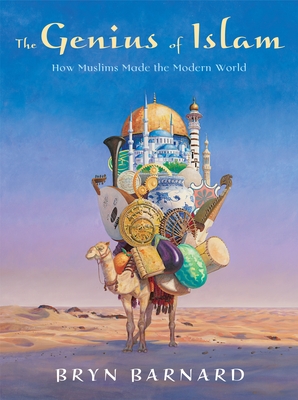
The Genius of Islam: How Muslims Made the Modern World


The Genius of Islam: How Muslims Made the Modern World
written and illustrated by Bryn Barnard, 2011. New York: Alfred A. Knopf. (9780375940729).

Media: oil on board, Adobe Illustrator and Adobe Photoshop

Author/Illustrator Website: http://www.brynbarnard.com/Site_2/Home.html

Awards and Honors: none

Annotation: Discusses the Muslim world's contributions to modern art, science, math, medicine, writing and architecture.

Personal Reaction:
      The Genius of Islam: How Muslims Made the Modern World is a well-intentioned and ambitious book that attempts to show how the contributions of the Muslim world have shaped the modern world in which we live. Bryn Barnard packs a lot of information into this book and his illustrations are quite beautiful. The format leaves something to be desired, though. For an indepth non-fiction book like this, a table of contents and an index would be welcome additions. Also, the insets on each page that aim to present additional information about each topic would be more effective if they were larger and easier to read. My biggest issue with the book, though, is that Barnard conflates the religion of Islam, the people of the Middle East, Arabs and the Muslim world. Not all are interchangeable and some text that defines the differences between these groups and ideas would help immensely. Overall The Genius of Islam: How Muslims Made the Modern World is a book with an interesting and important message that suffers from issues with editorial direction. It's too bad, because it has some really great material but it needs to be more clearly presented.

Dave the Potter: Artist, Poet, Slave


Dave the Potter: Artist, Poet, Slave
by Laban Carrick Hill, illustrated by Bryan Collier. 2010. New York: Litte, Brown and Company. (9780316107310).

Media: watercolor and collage on 400lb Arches watercolor paper

Author Website: http://www.labanhill.com/

Illustrator Website: http://bryancollier.com/

Awards and Honors: New York Times Bestseller; 2011 Caldecott Honor; 2011 Coretta Scott King Gold Award for Illustrations; Chicago Public Library's 2010 Best of the Best List; New York Public Library's 2010 Best 100 Books of the Year; Notable Social Studies Trade Books for Young People, 2011

Annotation:
At once personal and historical, this is the extraordinary story of Dave, a poet, potter and slave living in South Carolina during the 19th century.

Personal Reaction:
     Dave the Potter is the extraordinary story of Dave, a poet, potter and slave living in South Carolina during the 19th century. Laban Hill's simple yet noble prose and Bryan Collier's rich collage illustrations come together in this book to tell the story of one man who, despite having all freedom stolen from him, created lasting beauty and, we can imagine, a sense of dignity in his life. Dave's pots were meant to be functional pieces, but their beauty is plain to be seen. What's most incredible about his work is that on many of his pots, he inscribed short poems. In a time when reading and writing was forbidden to slaves, this was really something exceptional. This book really speaks to the innate human urge to create art and poetry that we hope will outlast our own temporal lives.

Thursday, August 4, 2011

Back of the Bus

Back of the Bus
by Aaron Reynolds, illustrated by Floyd Cooper. 2010. New York: Penguin Group. (9780399250910).

Author Website: http://www.aaron-reynolds.com/

Illustrator Website: http://www.floydcooper.com/

Media: oil paint

Annotation:
The story of Rosa Parks, as seen through the eyes of a young boy on the Montgomery, Alabama bus that fateful day in 1955.

Personal Reaction:
     Aaron Reynolds imagines Rosa Park's 1955 act of civil disobedience on a Montgomery, Alabama bus in his book Back of the Bus. This is the famous story as seen through the eyes of a young African American boy. The nameless boy and his mother witness firsthand Rosa Park's refusal to move from her seat and her subsequent arrest. The boy is nervous but his mother assures him (somewhat ironically) that, "Tomorrow all this'll be forgot". Reynolds  writes in the boy's voice, using vernacular language which I find demeaning and borderline offensive most of the time. (The boy says things like, "I want me a drink real bad".) While there's nothing terrible about the book, there's nothing particularly spectacular about it either. Floyd Cooper's illustrations are nice, but he's done better work (see Joyce Carol Thomas' I Have Heard of the Land or  Pat Sherman's Ben and the Emancipation Proclamation).

Busing Brewster


Busing Brewster
by Richard Michelson, illustrated by R.G. Roth. 2010. New York: Alfred A. Knopf. (9780375933349)

Media: ink, watercolor and collage

Author Website: http://richardmichelson.com/

Illustrator Website: none

Awards and Honors: New York Times: 10 Best Illustrated Books of 2010,
New York Times: 8 Notable Children’s Books of 2010, National Council for the Social Studies and Children's Book Council Notable Social Studies Trade Book for Young People 2011

Annotation: In 1971, Brewster becomes one of the first African American children to integrate the fictional Central School after the Supreme Court implements forced 'busing'.


Personal Reaction:
     In 1971, the United States Supreme Court implemented forced busing in an attempt to integrate public schools. Some black children were bused to white schools outside their neighborhoods and were met with racial hostility from the families of the new schools they were attending. This is the fictional story of Brewster, a young boy who becomes one of the first students to integrate Central School. Richard Michelson presents a short, simple story on a large topic as told through the eyes of a very young child just entering first grade. Because Brewster is too young to understand the implications of much of what is happening around him, it's a gentle introduction to a complex issue. In this regard Busing Brewster is much like Benno and the Night of Broken Glass, which introduces a troubling period of history by telling the story of Kristallnacht through the eyes of a neighborhood cat in Berlin. R.G. Roth's child-like illustrations, rendered in watercolor and collage, are even reminiscent of Josée Bisaillon's non-threatening illustrations from Benno and the Night of Broken Glass. Though Michelson does touch on the violence and ignorance Brewster experiences (a rock is thrown through the bus window by protesting parents and a student makes a racist comment to Brewster at school), it's kept at a gentle level to make the story accessible by younger kids. The ignorance is also tempered by an encouraging librarian, Miss O'Grady who reads to Brewster and encourages his dream of one day becoming president

Curriculum Connection: Elementary social studies, Civil Rights

Monday, August 1, 2011

Ubiquitous: Celebrating Nature's Survivors


Ubiquitous: Celebrating Nature's Survivors
by Joyce Sidman, illustrated by Beckie Prange, 2010. New York: Houghton Mifflin Books for Children. (978061871794).

Author Website: www.joycesidman.com

Illustrator Website: http://www.beckieprange.com/

Media: linocuts, hand-painted with watercolor

Awards and Honors: Starred reviews in Booklist, Publishers Weekly, School Library Journal, Kirkus, Horn Book; Junior Library Guild Selection; Publisher's Weekly, Best Books of the Year; Washington Post, Best Books of the Year; Kirkus, Best Books of the Year; School Library Journal, Best Books of the Year; National Science Teachers Association/Children's Book Council, Outstanding Science Trade Books, K-12, 2011; Boston Globe, Top Ten Children's Books of 2010; New York Public Library's "100 Best Books"; Booklist, Top 10 Sci-Tech for Youth; Book Links, Lasting Connections for 2010; Finalist for the 2011 CYBILS Poetry Award; Association for Library Service to Children Notable Children's Book; The John Burroughs List of Nature Books for Young Readers


Annotation:
Joyce Sidman's poetic tribute to some species that have been spectacularly successful from an evolutionary point of view. 

 
Personal Reaction/Discussion of Artwork:
    
Joyce Sidman is a master of using poetry to teach children about science and nature. In Ubiquitous her compelling verses, paired with Beckie Prange's illustrations, tell the story of some of Earth's most successful species. 


     Prange's lovely hand-colored linocut prints are gorgeously composed and bold while still retaining a charming rawness. Her illustrations exhibit so much variety that they keep a real energy about the book. One page may show the moon as seen from the perspective of someone laying in the grass, while another presents lichens, seven times their actual size, spreading gracefully across the page, and yet another shows the lifecycle of the dung beetle as a circle of spheres on a blank white page. The endpapers in particular are really spectacular- Prange has created a timeline to show when the various lifeforms appeared on Earth using a string 46 meters long, coiled and looped, each centimeter equalling 1 million years. The string gently shifts in color, from red to orange to yellow, and through the colors of the rainbow, to represent changes in the Earth's geologic periods. Of the fourteen species represented on the timeline only one, bacteria,  appears on the left hand side of the spread. The other thirteen are bunched up towards the end of the timeline, and humans appear at the very tip of the string. It's an effective way to visually represent how young humans really are as a species

     Sidman's poems are as delightfully varied in form as the species they discuss. They range from a rapid-fire stream of consciousness rant by a squirrel, to a classical ode on a mollusk's shell, to a poem about sharks in the shape of (what else?) a shark. Opposite each poem is a short factual paragraph about each species, explaining the special characteristics that have made them successful on Earth. As with Sidman's other works, you're never quite sure if this is a book of poems masquerading as science, or an informational volume dressed up as art. Ubiquitous is an visually arresting, inventive, and sometimes whimsical blurring of the division between art and science.

Allusion:
"... I am Sheath-wing, beloved of ancients... As the sun-god rolls his blazing disk overhead, so I roll my perfect sphere of dung across the sands... Blessed by the gods are you who hold me in your hands."
 - refers to the worship of the dung, or scarab, beetle by ancient Egyptians and the parallels drawn between the beetle and the sun god, Ra


Personification:
"Did you know/ dandelions grow the hair/ just as we do?/ Each pale, silky thread/ springs straight/ from their head./ They were all blondes,/ of course,/ and each one/ a star."

Curriculum Connection:
Elementary school science- Biology

Black Jack: The Ballad of Jack Johnson


Black Jack: The Ballad of Jack Johnson
by Charles R. Smith, illustrated by Shane W. Evans, 2010, New York: Roaring Brook Press. (9781596434738).


Illustrator Website: http://www.shaneevans.com/

Media: pen and ink, oil paint and collage

Awards and Honors: IRA Notable Books for a Global Society; Chicago Public Library Best of the Best; Booklist, Starred Review; Publishers Weekly, Starred Review; School Library Journal, Starred Review

Annotation:
A biography, in rhyming verse, of Arthur John "Jack" Johnson, the world's first black heavyweight champion.

Personal Reaction:
     With rhyming verse and bold illustrations Charles R. Smith and Shane W. Evans tell the story of Jack Johnson, the world's first black heavyweight champion. A "brave, strong, fightin' man", Jack was determined to become a "great man"- a dream he accomplished when he defeated Jim Jeffries on the Fourth of July in 1910. Smith does a masterful job at writing Johnson's story- he's able to balance historical detail with really entralling storytelling. A non-fiction book told in rhyming verse and shining with personality is a rarity. Evans' illustrations, rendered in big blocks or deep color, are bold and dynamic. He includes historic newspaper clippings and photos of Johnson as subtle collage details that lend to the story. Black Jack: The Ballad of Jack Johnson is a great example of a how a non-fiction story can be told creatively and compellingly.

Saturday, July 30, 2011

Queen of the Falls


Queen of the Falls
written and illustrated by Chris Van Allsburg, 2011. New York: Houghton Mifflin Books for Children. (9780547315812).

Author/ Illustrator Website: http://www.chrisvanallsburg.com/home.html

Media: pencil

Awards and Honors: none

Annotation:  
As tall as a seventeen story building and unimaginably powerful, the Niagara Falls have long inspired awe in everyone who visits this natural wonder. This is the story of Annie Edson Taylor, the first person to go over Niagara Falls in a barrel.

Personal Reaction:
      Chris Van Allsburg, well-known for his fantastical works of surrealistic fiction, tackles the story of Annie Edson Taylor the first person to ever go over Niagara Falls in a barrel. In 1901 Taylor was a 62 year old widow and retired charm school teacher, running low on money, when she decided that a trip over the falls might be just the thing to buoy her flagging finances. (Even though this is a true story, I was a bit perplexed as to how, after reading a newspaper article abut visitors to the falls, Taylor came to this conclusion.) Impressively enough, we learn that Taylor herself designed and commissioned a special barrel to be built that would be strong enough to withstand a trip over the falls and safe enough to protect her during the fall. She also had the forethought to hire a PR man who would drum up interest in her story and later manage her public appearances. 
   
     Taylor's trip over the falls was successful, of course, but her dreams of fame and fortune were not to be realized. She traveled the county fair circuits, making appearance and telling her story but the public wanted to see a real-life daredevil, not a "little old lady". Her manager steals her barrel, she gets it back, but gets a new manager who does the same, and she eventually has a new barrel made. She and her barrel end up in a park near the falls where she sells postcards of herself to passing tourists. 

     Taylor's story is pretty incredible. For a widowed woman of her age to attempt such a feat in 1901 is in itself quite amazing. But I had mixed feeling about the story: on one hand, this is an interesting argument for not judging a book by its cover, but Taylor's reasoning behind her stunt was just bizarre to me. Obviously financial gain was Taylor's primary concern, but how in the world she imagined such a dangerous stunt would be the answer to her problems was just plain weird. Its a shame that modern television reality shows weren't around in Annie Edson Taylor's time. If they were, she might just have realized her dreams.

Bones: Skeletons and How They Work


Bones: Skeletons and How They Work
written and illustrated by Steve Jenkins, 2010, New York : Scholastic Press. (0545046513).

Author/Illustrator Website: http://www.stevejenkinsbooks.com/

Media: paper collage

Awards and Honors: A Junior Library Guild Selection for Fall 2010, A Society of Illustrators Original Art Show choice

Annotation: A creative look at bones and skeletons of all shapes and sizes, what they do, and how they do it. 

Personal Reaction: 
     This is a wonderful picture book for children who are fascinated by bones or for educators to enrich lessons on the skeleton (human and otherwise). Steve Jenkins employs his trademark paper collage illustrations to explain how bones protect, support, and enable movement for all vertebrates. Cream collage skeletons on boldly colored solid pages are attention grabbers and Jenkins uses fold out double spreads to great effect in illustrating some spectacular full skeletons. One really neat feature of the illustations is that they are done to scale so that the reader can compare the sizes of various bones and animals. Jenkins includes additional facts, stories, history and science relating to bones at the end of the book. This is a book that elementary age kids (especially boys) will want to read again and again.

Curriculum Connection: Elementary school biology

Lesson Plan:

Subject Area:             
Biology

Suggested Grade Level:     
4-5

Lesson Title:             
Bones

Time:                 
1-2 hours

Materials/Equipment Required: 
- Bones: Skeletons and How They Work written and illustrated by Steve Jenkins
- modeling clay
- paper
- tape
- paper or plastic plates
- weights (wooden blocks)

Objectives: 
Students will learn about bones (the different types, how they protect the body, support it and allow it to move) and joints in the human body.

Suggested Procedure:         
Teacher will read aloud Bones: Skeletons and How They Work.

 Bone and Joint Activity:

1) Teacher will show students a picture of a bone pointing out the
         various parts of the bone, and reviewing important vocabulary. 
2) Students will create a clay model of the bone, labeling the parts
         of it.
3) Teacher will introduce the four joints of the human body. 
4) The teacher will demonstrate the movements of the joints. 
5) Students will brainstorm examples in the human skeletal system for each type of joint.

Bone Strength Activity:

1) Students will roll up half a sheet of letter-sized paper into a cylinder about 1 inch wide. They will make 3 of these.2) Students will stand the bones up on their ends and place a paper plate on top of the bones.
3) Students will begin to add weights (wooden blocks) to the plate.
4) Students will count how many blocks the plate can hold before the “bones" collapse.
5) Students will roll 3 more sheets of paper as tightly as they can so that there is no hollow section 
6) Students will stand these "bones" up as before placing the same plate on top of them.
7) Students will place weights on top of the plate until they collapse.
8) Students will deduce what happened. Teacher will explain that hollow
bones were able to support more weight. Teacher will continue explaining that the large bones in our body are also hollow, which makes them strong so they can support more weight, but light, so it takes less energy to move them.


Benno and the Night of the Broken Glass


Benno and the Night of the Broken Glass

by Meg Wiviott, illustrated by Josee Bisaillon, 2010. Minneapolis, Minnesota: Kar-Ben Publishing. (978082259929).

Media: collage, drawings and digital editing

Author Website: http://megwiviott.com/

Illustrator Website: joseebisaillon.com

Awards and Honors: Selected as one of School Library Journal's Best Books 2010: Picture Books; Winner of Moonbeam Children's Book Awards' Gold Medal for Multi-cultural Picture Book; CCBC's 2011 Best Choice List

Annotation: 
A picture book portrayal of Kristallnacht (The Night of Broken Glass) in Nazi Germany as seen through the eyes of Benno, the neighborhood cat.

Personal Reaction: 
     The human atrocities committed by Nazi Germany are a troubling and complex subject to teach to young children, but Benno and the Night of the Broken Glass is a sensitive and thoughtful introduction to the Holocaust. The violence is largely implied, and while it is jarring, it is not explicit or disturbing. By telling the story through the eyes of Benno, the neighborhood cat, readers are given a first-hand look at the destruction and persecution by an objective narrator. Because Benno is a neutral participant he describes the outward appearance of the events and doesn't delve into significance. However, by relating the devastion of Kristallnacht to one street in Berlin, Wiviott is able to personalize a disturbing historical event. An afterword gives the reader more details about Kristallnacht and a bibliography suggests sources for additional reading. This story lends itself to opening discussion about the persecution and murder of Jews during the Holocaust between parents or teachers and young children. 

Curriculum Connection: Elementary school history- Holocaust

The Little Prince


The Little Prince
by Antoine de Saint-Exupery, illustrated by Joann Sfar, 2010. New York: Houghton Mifflin Harcourt. (0547338023)

Illustrator Website: http://www.joann-sfar.com/wpen/

Media: pen and ink, with color applied digitally

Awards and Honors: Angoulême International Comic Strip Festival, "Essential"- Youth category

Annotation: 
A graphic novel adaptation of Antoine de Saint-Exupery's classic allegory, The Little Prince.  

Personal Reaction: 
     The Little Prince- a story of an aviator crashlanded in the African desert who encounters a strange little boy from the heavens- has long been a classic of children's literature. I was given a copy of this book when I was eight years old and I've read and reread it many times throughout the years, gaining a different understanding and appreciation for it upon each reading. Having read the novel many times, though, I expected that the graphic adaptation wouldn't do the original justice, that somehow it would be a watered down shadow of de Saint-Exupery's allegory. 

     I was pleasantly surprised to find that Joann Sfar's graphic novel is not at all the bore that I expected, but actually manages to infuse the story with a deep sentiment and meaning. Where de Saint-Exupery's voice is at times detached, Sfar's adaptation is tender without being syrupy. The affection the pilot feels for the Little Prince is palpable, and the departure of the Little Prince at the end of the story is truly moving. While Sfar's illustrations may not be as charming as the originals, they likely open up the world of The Little Prince to a greater audience.

Thursday, July 14, 2011

Blockhead: The Life of Fibonacci


Blockhead: The Life of Fibonacci
by Joseph D'Agnese, illustrated by John O'Brien, 2010. New York: Henry Holt and Company. (9780805063059).

Media: pen and watercolor

Author Website: http://www.josephdagnese.com/Welcome.html

Illustrator Website: none

Awards and Honors: Best 2010 Science Books for Kids — Smithsonian Magazine, Best Children’s Books of the Year — Bank Street College, Noteworthy Books for Children and Teens — Capitol Choices, 2011 ALSC Notable Nominee, Best Books for 2010 — Children’s Book Compass

Annotation:
     Leonardo Fibonacci is considered one of the greatest Western
mathematicians, but it wasn't always this way. When he was a kid he
daydreamed about numbers so much that people called him "Blockhead", until he learned that there's nothing stupid about following your passion.

Personal Reaction:
      Leonardo loves numbers and he thinks about them day and night. He daydreams about numbers so much that people begin calling him "Blockhead". Leonardo tries to ignore them and follows the advice of a friend who tells him, "... learn all you can about numbers. That way you will always be happy". This is a story not only about the mathematician known as Leonardo Fibonacci, but also about following your passion regardless of what other people think

     Even though Fibonacci lived almost 900 years ago, Joseph D'Agnese's first-person narrative style makes the story accessible for children and relatable enough that it seems as if it could have happened yesterday. D'Agnese takes what little is known about Fibonacci's life and skillfully pieces it together with a bit of imagination to fortify the tale. It's a kid friendly story filled with dashes of humor- when Leonardo's portly friend encourages him to follow his dreams, he says matter-of-factly, "I think people are happiest when the know what pleases them. Me, I love cheese". In another scene, Leonardo visits the palace of the Holy Roman Emperor who challenges him to solve "a bunch of really hard math problems". When Leonardo quickly completes the problems the Emperor calls Leonardo "one smart cookie". O'Brien's cheerful illustrations are filled with nautilus shells, sunflowers and ferns- all references to Fibonacci's famous pattern.

     Even if you are unfamiliar with Fibonacci and his famous numbers, Blockhead is well-crafted enough to enjoy simply on its own merits. This books would make an excellent addition to an upper elementary school classroom or library.

Curriculum Connection: 5th grade, math.

Tuesday, July 12, 2011

Ben and the Emancipation Proclamation


Ben and the Emancipation Proclamation
by Pat Sherman, illustrated by Floyd Cooper, 2010. Grand Rapids, Michigan: Eerdmans Books for Young Readers. (9780802853196).

Author Website: none

Illustrator Website: http://www.floydcooper.com/

Media: oil wash on board

Awards and Honors: none

Annotation: The true story of Ben, a young slave who teaches himself to read in a time when literacy was forbidden for African Americans. His ability to read proves important to others when President Lincoln issues the Emancipation Proclamation.

Personal Reaction: Author Pat Sherman and Coretta Scott King Award winning illustrator, Floyd Cooper tell the touching true story of Benjamin Holmes, a young slave living during the Civil War who teaches himself to read. Ben's father teaches him the alphabet before he is sold and when Ben is apprenticed to a tailor in Charleston he practices reading while running errands for his boss. Ben reads street signs, shopping lists and even bits of discarded newspaper.

    Ben knows to hide the fact that he can read and write- it's dangerous for a slave to be educated and he has to be very careful. But he is not able to hide his reading and writing from the other slaves for long. Word gets around and wherever Ben's errands take him slaves implore Ben to teach them to read and write. Before long the Union Army pushes closer towards Charleston and Ben's employer flees, leaving Ben in a slave prison. Weeks pass while Ben and his fellow prisoners are cut off from any news of the War. One night the prisoners bribe a guard to get the latest copy of the Charleston Mercury and ask Ben to read the message from Abraham Lincoln that is printed inside- the Emancipation Proclamation. The author's note tells readers that Ben did not immediately gain his freedom but ended up working in several businesses. He eventually enrolled in Nashville's Fisk University, traveled internationally with Fisk's chorus and taught in a rural school before dying of tuberculosis sometime during the 1870s.

   The story is a testament to the power of the written word and the liberating force of education. Pat Sherman has done a wonderful job of telling Ben's story so that it is powerfully moving without being sentimental or saccharine. Floyd Cooper's expressive and sensitively rendered illustrations  pair well with Sherman's prose. Ben and the Emancipation Proclamation would make an excellent book to use with elementary aged children in lessons on slavery and the Civil War.

Curriculum Connection: 4th Grade, Civil War, Emancipation Proclamation

Sunday, July 10, 2011

Dark Emperor & Other Poems of the Night


Dark Emperor & Other Poems of the Night
by Joyce Sidman, illustrated by Rick Allen, 2010. New York: Houghton Mifflin Books for Children. (9780547152288).

Author Website: http://www.joycesidman.com/

Illustrator Website: http://www.beckieprange.com/

Media: relief prints, handcolored with gouache

Awards and Honors: Newbery Honor Book, 2011; CCBC Choices, 2011; NCTE Notable Children's Trade Book, 2011; New York Times Bestseller, 2011; ALA Notable Children's Book, 2011; Horn Book Fanfare Selection, 2011; Kirkus Reviews Best Books of the Year, 2010; Bulletin Blue Ribbon Book, 2010; Lee Bennett Hopkins Poetry Award Honor Book; Boston Globe/Horn Book Award Honor Book; Cybils Poetry Award Finalist; Booklist Editor's Choice; CBC Bank Street Best Book of the Year (starred); Chicago Public Library Best book of the Year; NSTA-CBC Outstanding Science Trade Book


Annotation: Joyce Sidman's poems explore the bustling, buzzing nocturnal forest and shed light on the woodland creatures who inhabit the night.

Personal Reaction: A beautiful and ingenious blend of non-fiction book and poetry collection. Sidman's poems are haunting and evocative, imbuing the nighttime forest with a beguiling enchantment. These poems are a sensory feast and emphasize the smells, sounds and feelings of the night, accentuating the importance of all the senses for nocturnal animals who don't rely primarily on vision:
"Come feel the cool and shadowed breeze,
come smell your way along the trees,
come touch rough bark and leathered leaves:
Welcome to the night." (p.6)
    Each spread highlights one denizen of the night forest through a poem accompanied by an informational sidebar. Sidman often writes these poems in first person, using the animals or plants as narrator. Her factual sidebars provide the reader with additional information that expounds upon the poems. "Cricket Speaks" is narrated by a cricket eager for the "trilling hour" to come so that he can "sing, sing, till the branches tremble" (p. 20). The sidebar teaches readers that a cricket's trill is called stridulation and female crickets will pick a mate based on the strength of his song. Sidman provides a glossary at the back of the book for words and concepts with which children may be unfamiliar. 

    Allen's illustrations, gouache colored linoleum prints, are beautifully textured and rich with detail. Double spread, full bleed illustrations at the beginning and end of the book act as wordless opening and closing scenes; one depicts the sun setting and an owl- the eponymous "Dark Emperor"- taking wing, the next shows the sun rising and the owl roosting in the tree tops. 

Use of Onomatopoeia: (p. 6) "To all of you who crawl and creep,/ who buzz and chirp and hoot and peep."
(p. 12) "What symphonies of/ squeaks and skitters, darts/ and rustles, swell the vast,/ breathing darkness of your realm?"
(p. 18) "We mew and coo a soft duet." 

Use of simile: (p.22) "Like noses pink/ in midnight air,/ like giants' ears,/ like elfin hair,/ like ancient cities/ built on cliffs,/ the mushrooms come,/ the mushrooms come."

Curriculum Connection: 3rd grade, science- nocturnal/diurnal animals, language arts, poetry

Friday, July 8, 2011

Can We Save the Tiger?


Can We Save the Tiger?

written by Martin Jenkins and illustrated by Vicky White, 2011, Somerville, Massachusetts : Candlewick Press. (0763649090).

Media: pencil and oil paint

Author Website: none

Illustrator Website: none

Awards and Honors: none

Annotation: Discusses endangered species and the role humans can play in threatening as well as rehabilitating their populations.

Personal Reaction: Jenkins and White have created a very special book with Can We Save the Tiger?. Sensitive and balanced without being preachy, Can We Save the Tiger? introduces children to well-known endangered species such as the tiger, but also makes a point of teaching about other less cuddly endangered animals like the Indian vulture and the Partula snail. I like that Jenkins not only discusses endangered animals, but also teaches children about animals like the bison and the rhinocerous, that were once endangered but through the actions of humans have been brought back from the brink of extinction. He also avoids condemning humans, explaining that sometimes the actions of people trying to house themselves and produce the things they need have resulted in harming animals: 
 
"So if you were a poor farmer trying to make a living with a couple of cows and a few goats, you might not be too happy if you found out there was a hungry tiger living nearby. And if you knew that someone might pay you more for a tiger skin and some bones than you could earn in three whole months working the fields, then you might find it very tempting to set a trap or two, even if you knew it was against the law". 
Jenkins' prose is warm and conversational and Vicky White's beautiful, delicately detailed illustrations really make the book. Using pencil and occasionally oil paints, she imbues each animal with a lifelike realism. Her animals, whether feathered, furry, scaly or slimy, are richly textured and seem to almost leap from the page. All in all, Can We Save the Tiger? is a wonderful, sensitive introduction to endangered animals for elementary aged children. 

Curriculum Connection: 
Elementary School biology

Lesson Plan:

Subject Area:             
Biology

Suggested Grade Level:     
4-5

Lesson Title:             
Causes of Extinction (adapted from Scholastic’s website:  http://www2.scholastic.com/browse/lessonplan.jsp?id=391)

Time:                 
1-2 hours

Materials/Equipment Required: 
-Can We Save the Tiger? By Jenkins and White

Objectives: 
There are five major causes of extinction: habitat loss, an introduced species, pollution, population growth, and overconsumption. Through the activity, students will create a list of reasons why animals can become extinct and learn the acronym HIPPO as a way of remembering causes of extinction.

Suggested Procedure:          

1.    Teacher will read aloud Can We Save the Tiger? to the class.
2.    Teacher will create scenario cards for each of the below causes of extinction. Multiple examples of each cause will be needed. An example: A species of bird lived in wetlands until trash and chemicals made them sick (pollution), A species of fish lived in streams and rivers until a new, invasive species of fish came and started eating them (introduced species)
3.    Write this acronym on the board and discuss each cause:
     
H- Habitat loss
I - Introduced species
P- Pollution
P- Population growth
O- Overconsumption 
   4. Read the scenario cards and have students give the cause (habitat loss, introduced species, pollution, population growth, overconsumption) behind each scenario.