Showing posts with label poetry. Show all posts

Saturday, August 4, 2012

A Visit to William Blake's Inn

A Visit to William Blake's Inn: Poems for Innocent and Experienced Travelers. by Nancy Willard. illustrated by Alice and Martin Provensen (1981). 48p. New York: Harcourt Brace.  

Awards and Honors: Newbery Medal, Caldecott Honor

Review
A collection of poetry about an imaginary inn belonging to the poet William Blake and its fantastical guests and staff. Sun flowers, tigers, rabbits and cats inhabit the magical inn where they interact with each other and with the owner. Accompanying the poems are the Provensens' illustrations, rendered in muted earth tones, detailed, yet old-fashioned seeming, in keeping with the tone of the poems. Willard's language is rich, employing words like 'prodigious' and 'incommodious'.

Opinion:
Even though the language is difficult, I feel that younger readers would get the most enjoyment from this book with its fanciful illustrations and imaginative poems.

Ideas:
I'd use this book for a language arts class to enrich a lesson on William Blake. 

Friday, July 6, 2012

Good Masters! Sweet Ladies! Voices From a Medieval Village


Good Masters! Sweet Ladies! Voices From a Medieval Village. by Laura Amy Schlitz. illustrated by Robert Byrd. 2007. 85p. Cambridge, MA: Candlewick Press. 

Genre: poetry

Honors and Awards: Newbery Medal
Review
School librarian Laura Amy Schlitz wrote the poems of Good Masters! Sweet Ladies! to be performed by a large group of students who were putting on a play, but each wanted an important part to in the production. The result of her work is a stunning collection of tales- historically informative yet incredibly moving- that each detail the life of a young person living in a feudal English  village during the 13th century. Each monologue delivers an powerful story, and when considered as a whole the stories comprise an illuminating portrait of the social, economic and political structures of Medieval England. 

Opinion:
Though this book has been on my radar for years, neither the cover nor the title immediately appealed to me, and I had always hesitated to pick it up. But when I read the book, I was absolutely blown away. It's wonderfully rich; at times wryly funny, at times absolutely devastating in its beauty and its pathos. I think that this is a superb book, but it's one that tweens may need a bit of prodding to pick up. I'd recommend it to kids looking for books of poetry and I think it'd see great use in classrooms.
Ideas
Good Masters! Sweet Ladies! would be an obvious and excellent addition to lessons on Medieval history, or could be used in an English classroom to teach poetry appreciation. Pair this book with other fiction titles (Cushman's The Midwife's Apprentice, de Angeli's The Door in the Wall, etc.) and non-fiction books on Medieval history for a library display.

Sunday, June 10, 2012

Out of the Dust


Out of the Dust. By Karen Hesse. 1999. P. Newbery Medal, 1998.

Full of dark and evocative imagery, Out of the Dust is the story of Billie Jo, a 12-year-old farmer’s daughter living in Dust Bowl Oklahoma during the Great Depression. Only child Billie Jo lives with her mother and father in a small tight knit rural town where they eke out a hardscrabble existence. While drought and starkness dominate the countryside, Billie Jo’s piano playing and the impending arrival of a new baby are causes for hope in her life. But when a tragic and gut wrenching accident destroys both of these, Billie Jo and her father are thrown into a maelstrom of grief and guilt that rivals the vicious dust storms that rage across the prairies.  

In free verse poems, Hesse relates their stories crafting haunting visuals that stay with the reader long after the book is finished. Through the unrelenting anguish, there are small glimmers of hope that appear in the love and compassion that humans show each other in times of tragedy. An excellent and moving work of historical fiction.   

Inside Out & Back Again


Inside Out and Back Again. by Thanhha Lai. 2011. 260p. New York: HarperCollins. Newbery Honor, 2011.

In a series of free verse poems which act as diary entries, Inside Out and Back Again is the story of a year in the life of a young South Vietnamese girl as she flees her home with her mother and brothers, and struggles to build a new life in America. Though life in Saigon in 1975 is fraught with uncertainties, ten-year-old Há loves the sights, sounds, smells and rhythms of her hometown, which are richly evoked in Lai’s heady descriptions. When North Vietnamese troops take over the city, Há’s family is forced to make the heartbreaking decision to leave behind everything they know, including her father who has been missing in action for several years, in order to seek refuge in a foreign land.

Há and her mother and brothers end up in Alabama where they must each make their own place in an entirely new and sometimes hostile world. Há sees her new town as colorless and lonely; she struggles with learning a new language and faces school bullies who taunt her for her differences, yet she also learns kindness from her sponsor and a neighbor who both defend and support Há through her travails.

This is a sad, beautiful and hopeful book told in simple, yet profound language. Readers both young and old will be deeply moved by Há‘s story.

Monday, August 1, 2011

Ubiquitous: Celebrating Nature's Survivors


Ubiquitous: Celebrating Nature's Survivors
by Joyce Sidman, illustrated by Beckie Prange, 2010. New York: Houghton Mifflin Books for Children. (978061871794).

Author Website: www.joycesidman.com

Illustrator Website: http://www.beckieprange.com/

Media: linocuts, hand-painted with watercolor

Awards and Honors: Starred reviews in Booklist, Publishers Weekly, School Library Journal, Kirkus, Horn Book; Junior Library Guild Selection; Publisher's Weekly, Best Books of the Year; Washington Post, Best Books of the Year; Kirkus, Best Books of the Year; School Library Journal, Best Books of the Year; National Science Teachers Association/Children's Book Council, Outstanding Science Trade Books, K-12, 2011; Boston Globe, Top Ten Children's Books of 2010; New York Public Library's "100 Best Books"; Booklist, Top 10 Sci-Tech for Youth; Book Links, Lasting Connections for 2010; Finalist for the 2011 CYBILS Poetry Award; Association for Library Service to Children Notable Children's Book; The John Burroughs List of Nature Books for Young Readers


Annotation:
Joyce Sidman's poetic tribute to some species that have been spectacularly successful from an evolutionary point of view. 

 
Personal Reaction/Discussion of Artwork:
    
Joyce Sidman is a master of using poetry to teach children about science and nature. In Ubiquitous her compelling verses, paired with Beckie Prange's illustrations, tell the story of some of Earth's most successful species. 


     Prange's lovely hand-colored linocut prints are gorgeously composed and bold while still retaining a charming rawness. Her illustrations exhibit so much variety that they keep a real energy about the book. One page may show the moon as seen from the perspective of someone laying in the grass, while another presents lichens, seven times their actual size, spreading gracefully across the page, and yet another shows the lifecycle of the dung beetle as a circle of spheres on a blank white page. The endpapers in particular are really spectacular- Prange has created a timeline to show when the various lifeforms appeared on Earth using a string 46 meters long, coiled and looped, each centimeter equalling 1 million years. The string gently shifts in color, from red to orange to yellow, and through the colors of the rainbow, to represent changes in the Earth's geologic periods. Of the fourteen species represented on the timeline only one, bacteria,  appears on the left hand side of the spread. The other thirteen are bunched up towards the end of the timeline, and humans appear at the very tip of the string. It's an effective way to visually represent how young humans really are as a species

     Sidman's poems are as delightfully varied in form as the species they discuss. They range from a rapid-fire stream of consciousness rant by a squirrel, to a classical ode on a mollusk's shell, to a poem about sharks in the shape of (what else?) a shark. Opposite each poem is a short factual paragraph about each species, explaining the special characteristics that have made them successful on Earth. As with Sidman's other works, you're never quite sure if this is a book of poems masquerading as science, or an informational volume dressed up as art. Ubiquitous is an visually arresting, inventive, and sometimes whimsical blurring of the division between art and science.

Allusion:
"... I am Sheath-wing, beloved of ancients... As the sun-god rolls his blazing disk overhead, so I roll my perfect sphere of dung across the sands... Blessed by the gods are you who hold me in your hands."
 - refers to the worship of the dung, or scarab, beetle by ancient Egyptians and the parallels drawn between the beetle and the sun god, Ra


Personification:
"Did you know/ dandelions grow the hair/ just as we do?/ Each pale, silky thread/ springs straight/ from their head./ They were all blondes,/ of course,/ and each one/ a star."

Curriculum Connection:
Elementary school science- Biology

Saturday, July 23, 2011

A River of Words: The Story of William Carlos Williams


A River of Words: The Story of William Carlos Williams
by Jen Bryant, illustrated by Melissa Sweet, 2008. Grand Rapids, MI: Eerdmans Books for Young Readers. (9780802853028).

Author Website: http://www.jenbryant.com/

Illustrator Website: http://melissasweet.net/

Awards and Honors: About.com- Best Children's Books of 2008; Book Links- Lasting Connections of 2008; Caldecott Honor Book, 2009; Christian Science Monitor- Best Children's Books of 2008; CLN Chapter & Verse Book Club Selection; Cooperative Children's Book Center- Charlotte Zolotow Honor Award, 2009; Cybils Award Finalist, 2008; Junior Library Guild Selection; Kirkus Reviews- Best Children's Books of 2008; NCTE Notable Children's Books in the Language Arts, 2009; NCTE Orbis Pictus Award, 2009; New York Times Book Review- Best Illustrated Children's Books of 2008; Parents' Choice Award Recommended winner, 2008; School Library Journal Best Books, 2008.

Media: watercolor, collage and mixed media

Annotation: A visually stunning biography of physician and poet, William Carlos Williams.

Personal Reaction/ Discussion of Artwork:

When I was younger
it was plain to me
I must make something of myself.
            - William Carlos Williams,
              "Pastoral"

     Jen Bryant begins her picture biography of the poet, William Carlos Williams, with this quote taken from his own verse. While enamored with words, Williams felt obligated to "make something" of himself and followed his duty to seek a profession. Though Williams is perhaps best known for his contributions to modern American poetry, he was also a doctor who delivered an estimated 3,000 babies during his career. Bryant tells the story of how William Carlos Williams served the community as a doctor, while still pursuing his passion for poetry.  

     Bryant focuses on Williams' childhood, his love for nature and its rhythms, and his love of poetry and art. Bryant's prose is simple and lyrical, echoing Williams' own verse. Often her words even look like the lines of a poem:
"I have never seen a swan or an archer," Willie thought.
"I want to write about ordinary things-
plums, wheelbarrows, and weeds, 
fire engines, children, and trees- 
things I see when I walk down my street
or look out my window."
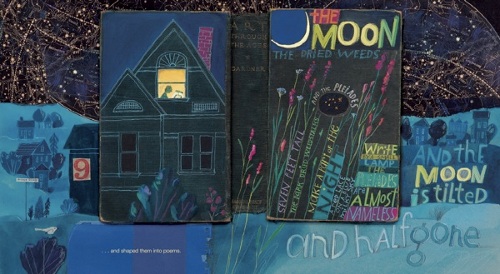
     This is also a visually beautifully book. Melissa Sweet's brightly colored, richly textured and layered collages provide a depth to this book that invites multiple re-readings. Upon examining the illustrations, we see Sweet has incorporated stationery, notebooks and even pages of medical books into her collages. Additionally, Sweet adds even more depth by working in to her collages Williams' own poems. In the spread pictured above, Sweet has turned Williams' poem "The Descent of Winter" into a gorgeous nighttime scene. We can see Williams' silhouette in the upstairs window of his home. The lines of the poem are spread out over the pages and Sweet has beautifully depicted the images of the poem: the moon, the dried weeds and the Pleiades. The collaged book covers and starcharts combined with Sweet's color palette of rich blues creates a lovely, evocative effect.

     All in all, Bryant and Sweet have created a wonderful book with A River of Words- simple and charming enough to be enjoyed by a young child, yet with a beauty and depth that will captivate adults as well.

Curriculum Connection: 6th grade- Language Arts/poetry

Sunday, July 10, 2011

Dark Emperor & Other Poems of the Night


Dark Emperor & Other Poems of the Night
by Joyce Sidman, illustrated by Rick Allen, 2010. New York: Houghton Mifflin Books for Children. (9780547152288).

Author Website: http://www.joycesidman.com/

Illustrator Website: http://www.beckieprange.com/

Media: relief prints, handcolored with gouache

Awards and Honors: Newbery Honor Book, 2011; CCBC Choices, 2011; NCTE Notable Children's Trade Book, 2011; New York Times Bestseller, 2011; ALA Notable Children's Book, 2011; Horn Book Fanfare Selection, 2011; Kirkus Reviews Best Books of the Year, 2010; Bulletin Blue Ribbon Book, 2010; Lee Bennett Hopkins Poetry Award Honor Book; Boston Globe/Horn Book Award Honor Book; Cybils Poetry Award Finalist; Booklist Editor's Choice; CBC Bank Street Best Book of the Year (starred); Chicago Public Library Best book of the Year; NSTA-CBC Outstanding Science Trade Book


Annotation: Joyce Sidman's poems explore the bustling, buzzing nocturnal forest and shed light on the woodland creatures who inhabit the night.

Personal Reaction: A beautiful and ingenious blend of non-fiction book and poetry collection. Sidman's poems are haunting and evocative, imbuing the nighttime forest with a beguiling enchantment. These poems are a sensory feast and emphasize the smells, sounds and feelings of the night, accentuating the importance of all the senses for nocturnal animals who don't rely primarily on vision:
"Come feel the cool and shadowed breeze,
come smell your way along the trees,
come touch rough bark and leathered leaves:
Welcome to the night." (p.6)
    Each spread highlights one denizen of the night forest through a poem accompanied by an informational sidebar. Sidman often writes these poems in first person, using the animals or plants as narrator. Her factual sidebars provide the reader with additional information that expounds upon the poems. "Cricket Speaks" is narrated by a cricket eager for the "trilling hour" to come so that he can "sing, sing, till the branches tremble" (p. 20). The sidebar teaches readers that a cricket's trill is called stridulation and female crickets will pick a mate based on the strength of his song. Sidman provides a glossary at the back of the book for words and concepts with which children may be unfamiliar. 

    Allen's illustrations, gouache colored linoleum prints, are beautifully textured and rich with detail. Double spread, full bleed illustrations at the beginning and end of the book act as wordless opening and closing scenes; one depicts the sun setting and an owl- the eponymous "Dark Emperor"- taking wing, the next shows the sun rising and the owl roosting in the tree tops. 

Use of Onomatopoeia: (p. 6) "To all of you who crawl and creep,/ who buzz and chirp and hoot and peep."
(p. 12) "What symphonies of/ squeaks and skitters, darts/ and rustles, swell the vast,/ breathing darkness of your realm?"
(p. 18) "We mew and coo a soft duet." 

Use of simile: (p.22) "Like noses pink/ in midnight air,/ like giants' ears,/ like elfin hair,/ like ancient cities/ built on cliffs,/ the mushrooms come,/ the mushrooms come."

Curriculum Connection: 3rd grade, science- nocturnal/diurnal animals, language arts, poetry