Showing posts with label onomatopoeia. Show all posts

Sunday, July 31, 2011

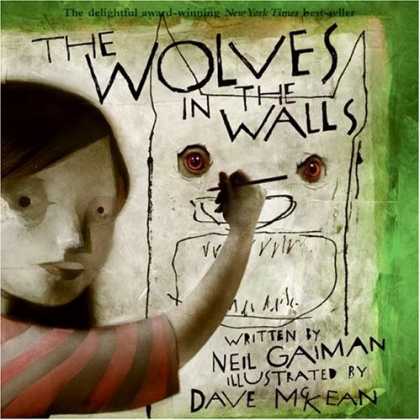
Wolves in the Walls


Wolves in the Walls
by Neil Gaiman, illustrated by Dave McKean, 2003, New York: Harper Collins. (038097827X).

Author Website: http://www.neilgaiman.com/

Illustrator Website: http://www.davemckean.com/


Media: mixed media (photography, drawing, computer generated images)

Awards and Honors: New York Times Best Illustrated Children's Book (2003), IRA/CBC Children's Choice (2004) award, British Science Fiction Association award for Short Fiction (2003)

Annotation: A surrealistic tale of a young girl and her family who are plagued by an infestation of very messy, party loving wolves in their walls.

Personal Reaction:
     Neil Gaiman and illustrator Dave McKean are known for creating surreal, bizarre and slightly unhinged books for children. The Wolves in the Walls is no exception. Lucy is a young girl who believes there are wolves in the walls of her house, but her family all dismiss her fears while adding the foreboding warning, "If the wolves come out of the walls, then it's all over". 

     Of course, there really are wolves in the walls- ones who end up barreling out in the middle of the night. Lucy and her family flee the house and take shelter in the garden while the wolves live it up; watching television, plaing the tuba, eating toast and jam, and generally wreaking havoc in the house. While Lucy's family had initially been dismissive of her fears, they're now completely defeatist- no one wants to stand up to the wolves. There are suggestions of moving to the Arctic Circle, the Sahara Desert or outer space, but Lucy insists that it's not all over and she isn't going to live anywhere that's not her house. Ultimately, it is Lucy who summons up her courage and leads the charge to reclaim the house from the wolves. 
     
     While growing up kids face many fears and no matter how outlandish they may seem to adults, they are very real to children. The message of The Wolves in the Walls is that while sometimes your fears can be real, it is always possible to face them, no matter how frightening they can be.

Onomatopoeia: 
"They were hustling noises and bustling noises. They were crinkling noises and crackling noises. They were sneaking, creeping, crumpling noises."
"She heard rustlings and scratchings and squeezings and creakings in the old house..."

Friday, July 8, 2011

The Revolutionary John Adams


The Revolutionary John Adams 
written and illustrated by Cheryl Harness, Washington, D.C: National Geographic, 2003. (0-7922-6970-5).

Awards: Beacon of Freedom Award, Nominee, 2006.

Author Website:
None

Media: Rich watercolors on paper.

Annotation: 
Harness traces the life of President John Adams from his humble beginnings on a farm to the White House. This biography offers details of Adams’ work as a revolutionary, politician, lawyer, statesman and leader.

Personal Reaction: 
This biography is steeped in facts, but it is also a very personal story of a man’s life.  The author traces John Adams’ life from his birth on a farm in New England to his death on a farm not far away.  In between, the reader learns about the role of Adams in revolting against England, building the government of new nation, working side by side with Washington, Jefferson and Franklin, serving as Vice-President and President, as well as working as a statesman abroad.  The numerous quotes from Adams, familial details and excerpts from personal letters to his beloved wife Abigail allow for an insight into Adams life that makes this biography more memorable than others.   Harness uses sweeping watercolor paintings of people and maps to bring Adams’ time to life.  In just 40 pages, Harness not only tells Adams’ story, but the history of our emerging and young nation.  The personal perspective and illustrations provide an accessible history lesson for students in grades five to seven.

Use of  Simile:
(p.31) “news that plunked like a round black stone into the world of John and Abigail Adams.”

Use of Metaphor: (p.5) “stomach full of butterflies.” (p.26) “dug deep into his bag of political skills.”  (p.29) “Two old lions, France and England.”

Use of Alliteration:
  (p.16) “soldiers froze and failed.” (p.24) “diamond-decked Marie Antoinette.”  (p.32) “stump-stubbled Pennsylvania Avenue.”

Use of Onomatopoeia
:  (p.6) “John Adams fizzed with total and complete happiness.” (p.8) “People began to grumble.”  (p.11) “plunk . . .plunk . . .plunked boxes of tea into Boston Harbor.”

Use of Sophisticated Language:  (p. 26) “coaxed out of Holland official recognition and loans, lifeblood for his nation.”

Curricular Connection: California History / Social Science, Grade 5, California Standards: 5.6:   Students understand the course and consequences of the American Revolution.  5.7: Students describe the people and events associated with the development of the U.S. Constitution and analyze the Constitution’s significance as the foundation of the American republic.

Constitution Construction


Constitution Construction

written and illustrated by Boyd Bentley, 2003, Williamsburg, VA: Chester Comix. (0972961623).

Author/ Illustrator Website: http://www.chestercomix.com/comics/

Awards and Honors: Virginia Council for the Social Studies Friend of Education Award, 2003

Media: Black ink and colored markers on paper.

Graphic Novel: Comic book style book with multiple chapters.

Annotation: Chester the Crab has a dream about the United States Constitution.  The dream is in the form of a comic book and explains the plan for the government of the United States.

Personal Reaction:  So many kids, particularly reluctant readers,  love reading comics.  Chester Comix is a great way to engage students in grades 5, 8 and 10 in the content of the California subject standards for American history.   In just 24 pages, Bentley Boyd, under the guise of Chester the Crab, covers a lot of material related to the construction of the United States Constitution.  John Locke shares his ideas about life, liberty and property from a perch in a jungle wearing a loincloth.  Newspaperman John Peter Zenger fights for freedom of speech and freedom of press after transforming into Superman. An especially funny comic featuring Thomas Jefferson proves that comics can make complex and contentious subjects such as religious freedom easy to digest for students. Chester’s last dream turns the creation of the Articles of Confederation into a comic spin on Star Trek. Chester Comix are colorful, action-packed and fact-filled and the result is a fresh approach to teaching history to students ages 9 to 15 years. Boyd succeeds in succinctly presenting an important period of American history in an easy to understand format that will entertain and educate.  The book includes a comic-free index that will allow students to review key points of information with ease.  A website for Chester Comix features teaching guides and information about state education standards covered in Boyd’s creative work.

Use of Metaphor:  (p.22) The ship from Star Trek is a metaphor for  the United States government.

Use of Onomatopoeia:
  (p.3) “Wam” enliven the action as Locke fights for his rights against the gorilla and a tiger.

Use of Personification: 
  (p. 5) A gorilla personifies the concept of a monarchy government.

Curricular Connection: California History / Social Science, Grade 5, California Standards: 5.7: Students describe the people and events associated with the development of the U.S. Constitution and analyze the Constitution’s significance as the foundation of the American republic.

Sunday, June 26, 2011

For Liberty: The Story of the Boston Massacre


For Liberty: The Story of the Boston Massacre
written and illustrated by Timothy Decker, 2009, Asheville, North Carolina: Front Street Press. (9781590786086).


Media: pen and ink

Awards and Honors:
2009 Cybil Nominated title for Non Fiction (MG/YA)

Author/Illustrator Website: http://timothydecker.com/
Annotation: A stark, graphic novel style account of the Boston Massacre, one most significant events in the lead up to the Revolutionary War.

Personal Reaction:
Author and illustrator Timothy Decker builds this story of the Boston Massacre slowly in deliberate, measured prose, while his austere pen and ink drawings capture the drama and tension of the storyline. There's much lying beneath the surface in this deceptively simple book. Decker is economical with his words and images, yet he still manages to pack a wealth of historical detail into the story. Background on the political situation in the colonies and Great Britain is given at the beginning of the story and Decker concludes with the subsquent trial of the soldiers. This book presents a balanced account of a very dramatic chapter in United States history. Black and white illustrations complement the gravity of the historical event. For Liberty is different than many historical picture books in that there is no back matter such as a timeline or bibliography, but this book would make an excellent addition to any lesson on the Boston Massacre.
Use of Onomatopoeia: 
"Bells pealed throughout the city."
"They could hear the growing din as the talked." 
"The throng of colonists grew as did the roar of their cries." 
"The bells continued to ring as if signaling the new tragedy."


Use of Sophisticated Language:
"Quarter no fiendish soldiers in your homes. Welcome no ill bred thieves to your hearth. Protect your liberties in this doleful and dark time."
"...soldiers quartered in a populous town, will always occasion two mobs where they prevent one. They are wretched conservators of the peace."
Use of Rhythm/Repetition:
"The mob swelled.
The reasonable men went home.
The bellicose remained."

"Surely the mob would not assault a trained soldier.
Surely his men would not fire for fear of shooting their officer.
Certainly a show of force would dissolve the anger."

Curricular Connection: 
5th Grade History/ Social Studies, California State Board of Education Standards
5.5     Students explain the causes of the American Revolution.
1. Understand how political, religious, and economic ideas and interests brought about the Revolution (e.g., resistance to imperial policy, the Stamp Act, the Townshend Acts, taxes on tea, Coercive Acts).