Showing posts with label Newbery Medal. Show all posts

Saturday, August 4, 2012

The Midwife's Apprentice


The Midwife's Apprentice. by Karen Cushman. (1996). 144p. New York: HarperCollins.


Awards and Honors: Newbery Medal, 1996

Review:


The Midwife’s Apprentice is the story of a homeless, nameless orphan who after seeking shelter in the warmth of a trash heap ends up being apprenticed to a  harsh midwife in a medieval village. Jane the Midwife takes her in, not out of pity or kindness, but because she is looking for cheap labor, and names her Beetle. The girl soon renames herself Alyce, and begins to learn the midwife's trade. Although Alyce comes across many stumbling blocks, she is a plucky and likeable heroine who does not let her unlucky circumstances get the best of her. This is ultimately a story about hope and determination.

Opinion:
Alyce's determination through her travails left me rooting for her and wishing that Cushman had written a sequel to The Midwife’s Apprentice. Though I'm not much for books with a moral, I enjoyed the message of persistence and will.

Ideas
Use this book to enhance lessons on Medieval fiction.

Sunday, July 22, 2012

Bridge to Terabithia


Bridge to Terabithia. by Katherine Paterson. 1977. 128p. New York: Scholastic Press. 

Honors and Awards: Newbery Medal
Review
Fifth grader Jesse Aarons is the only boy in a family of four sisters growing up in rural Virginia. Jesse is known as the "fastest kid at school", a title which he values highly. When Leslie Burke, the new girl at school, outruns him in a race on her first day, Jesse is upset though he and Leslie soon form a close friendship. Together Jesse and Leslie create a secret kingdom that they name Terabithia. Through his relationship with Leslie and their secret world, Jesse learns to face his fears, and experiences a terrible loss that forces him to mature.
Opinion:
Bridge to Terabithia is a classic of middle grade literature and it's a wonderful example of exactly how powerful, moving and beautiful a book for youth can be. I was absolutely blown away by the book and only sorry that I had not read it early.
Ideas
Bridge to Terabithia is one of the most frequently challenged children's books and an excellent choice for a Banned Books Month display or in a discussion of intellectual freedom for kids.

Saturday, July 21, 2012

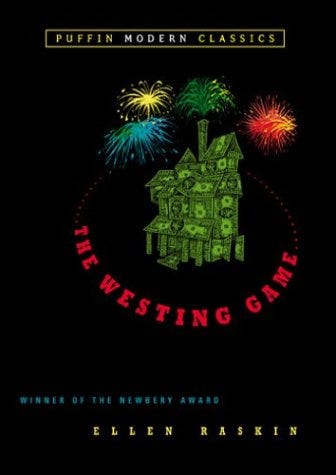
The Westing Game


The Westing Game. by Ellen Raskin. (1978). 182p. New York: Penguin Group.

Awards and Honors: Newbery Award

Review
A challenging and innovative novel for tweens, The Westing Game is an intricate "murder" mystery featuring upwards of 20 characters. Sixteen heirs are chosen to live in the newly built Sunset Towers which lies across Lake Michigan from millionaire Sam Westing's home. When Westing dies, the heirs are summoned to the home to hear his last will and testament. The will pairs them up into teams and plunges them into a competition to solve the mystery of Westing's death.

Opinion:
The Westing Game is original and interesting, though with so many characters it's hard to feel a solid connection to any of them. It can also be difficult to keep up with the plot, so I'd probably recommend this book for kids on the older end of the tween spectrum as younger, less experienced readers may be frustrated by the twists and turns.


Ideas:
The Westing Game is a solid addition to bibliographies of mystery books for tween readers.

Friday, July 6, 2012

Good Masters! Sweet Ladies! Voices From a Medieval Village


Good Masters! Sweet Ladies! Voices From a Medieval Village. by Laura Amy Schlitz. illustrated by Robert Byrd. 2007. 85p. Cambridge, MA: Candlewick Press. 

Genre: poetry

Honors and Awards: Newbery Medal
Review
School librarian Laura Amy Schlitz wrote the poems of Good Masters! Sweet Ladies! to be performed by a large group of students who were putting on a play, but each wanted an important part to in the production. The result of her work is a stunning collection of tales- historically informative yet incredibly moving- that each detail the life of a young person living in a feudal English  village during the 13th century. Each monologue delivers an powerful story, and when considered as a whole the stories comprise an illuminating portrait of the social, economic and political structures of Medieval England. 

Opinion:
Though this book has been on my radar for years, neither the cover nor the title immediately appealed to me, and I had always hesitated to pick it up. But when I read the book, I was absolutely blown away. It's wonderfully rich; at times wryly funny, at times absolutely devastating in its beauty and its pathos. I think that this is a superb book, but it's one that tweens may need a bit of prodding to pick up. I'd recommend it to kids looking for books of poetry and I think it'd see great use in classrooms.
Ideas
Good Masters! Sweet Ladies! would be an obvious and excellent addition to lessons on Medieval history, or could be used in an English classroom to teach poetry appreciation. Pair this book with other fiction titles (Cushman's The Midwife's Apprentice, de Angeli's The Door in the Wall, etc.) and non-fiction books on Medieval history for a library display.

Sunday, June 10, 2012

Out of the Dust


Out of the Dust. By Karen Hesse. 1999. P. Newbery Medal, 1998.

Full of dark and evocative imagery, Out of the Dust is the story of Billie Jo, a 12-year-old farmer’s daughter living in Dust Bowl Oklahoma during the Great Depression. Only child Billie Jo lives with her mother and father in a small tight knit rural town where they eke out a hardscrabble existence. While drought and starkness dominate the countryside, Billie Jo’s piano playing and the impending arrival of a new baby are causes for hope in her life. But when a tragic and gut wrenching accident destroys both of these, Billie Jo and her father are thrown into a maelstrom of grief and guilt that rivals the vicious dust storms that rage across the prairies.  

In free verse poems, Hesse relates their stories crafting haunting visuals that stay with the reader long after the book is finished. Through the unrelenting anguish, there are small glimmers of hope that appear in the love and compassion that humans show each other in times of tragedy. An excellent and moving work of historical fiction.   

A Wrinkle in Time


A Wrinkle in Time. by Madeleine L'Engle. 1962. 211p. New York: Farrar, Straus and Giroux. Newbery Medal, 1963.

Intellectually precocious, yet socially awkward Meg Murry is the oldest daughter in a family that includes her scientist mother, Kate; her strangely perceptive 5 year old brother, Charles Wallace; her 10 year old twin brothers, Sandy and Dennys; and her father, Dr. Alex Murry, who mysteriously went missing several years prior while involved in a top secret government project. Meg is an outcast at school, where she must deal with the constant gossip about her father’s whereabouts, as well as at home where she struggles to define herself amongst her unique family members. 

When a strange turn of events precipitated by a trio of eccentric old women sends Meg, Charles Wallace and their neighbor, Calvin, on an intergalactic journey to find and rescue their father who they learn has been imprisoned on another planet, Meg must begin to understand and accept her differences and recognize her own personal agency as a young adult.  

This is a sophisticated coming of age story that asks much of young readers as it tackles significant and timeless themes of love, individuality and good versus evil.

When You Reach Me


When You Reach Me. by Rebecca Stead. 2009. 199p. New York: Wendy Lamb Books. Newbery Medal, 2010

Twelve year old latch-key kid Miranda lives in New York City with her single mother. Set in the late 1970s, her New York neighborhood is a lively setting replete with an intriguing cast of characters, including her best friend Sal, a strange but brilliant boy named Marcus, and a ragged and raving homeless man she calls the Laughing Man. When a series of mysterious anonymous notes that seem to predict the future begin showing up amongst her belongings, Miranda attempts to piece together a mystery that hints at time travel and impending danger.

Stead ably weaves together a number of plot lines to create a genre-crossing novel that defies easy categorization- mystery, realistic fiction and coming of age story are all represented, with a special place given to science fiction. Indeed, Madeleine L’Engle’s A Wrinkle in Time, plays a prominent role in the story as Miranda’s favorite book as well as the inspiration for several details of Miranda’s life. The issues of race, class, friendships and growing up are realistically tackled as Miranda faces the challenges of adolescence, and Stead presents young readers with subtle life lessons.

Wednesday, May 23, 2012

The Whipping Boy


The Whipping Boy. by Sid Fleischman. illustrated by Peter Sis. 1987. 90p. New York: Greenwillow Books. Newbery Medal, 1987.

Fleischman channels The Prince and the Pauper in his 1987 Newbery winning novel, The Whipping Boy. Orphaned son of a commoner, Jemmy lives in the royal castle where he serves as a whipping boy for the spoiled and mischievous young heir, Prince Brat. When Prince Brat decides that he is bored with life at the royal court, he runs away dragging Jemmy along with him. Together the pair are begrudgingly forced to join together to outwit and outrun a pair of bandits who seek to collect a ransom on the Prince. A colorful cast of characters also includes a blind potato seller, a young girl named Betsy and a dancing bear.

Fleischman combines adventure, humor and suspense in this quick-paced story for children. The Whipping Boy is likely best for younger children, as more mature readers may find the story overly simplistic. The dialogue is clunky at points, most characters are one-dimensional and Fleischman is heavy-handed with the moral themes. The convenient ending works, but older readers may reject it as simplistic and naïve.