Showing posts with label fiction in graphic novel format. Show all posts

Friday, August 5, 2011

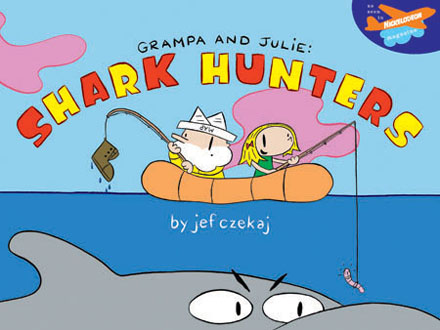
Grampa and Julie: Shark Hunters


Grampa and Julie: Shark Hunters
written and illustrated by Jef Czekaj. 2004. Somerville, Massachusetts: Czekaj Press. (189183052X). 

Media: pen and ink, digitally colored

Author/Illustrator Website: http://www.czekaj.com/

Awards and Honors: none

Annotation:
The misadventures of Grampa and Julie, who are on the hunt to find Stephen, the biggest shark in the world.

Personal Reaction:
     While children will probably be left in stitches, adults will likely scratch their heads at the misadventures of Grampa and Julie, a dynamic duo on a quest to find Stephen, the biggest shark in the world. Grampa and Julie: Shark Hunters  compiles three years of comic strips that were published in Nickelodeon Magazine. It's a bizarre little graphic novel starring a rapping chicken and squirrel, a gang of hungry monkeys, an all-knowing Snow Queen, and a pair of Abominable Snowmen, among other characters. Julie plays the straight man to Grampa, an absent-minded ichthyologist and something of a nutty professor. The story twists and turns unpredictably, taking them from the middle of the ocean, to outer space, to the North Pole. While I got dizzy from trying to keep up with the plot twists, kids will find the book, with its silly illustrations and offbeat humor, irresistible.

Monday, August 1, 2011

The Arrival


The Arrival
written and illustrated by Shaun Tan, 2006, New York: Arthur A. Levine Books. (0439895294).

Author/Illustrator Website: http://www.shauntan.net/

Media: pencil on paper

Awards and Honors: New South Wales Premier's Literary Award; 2006 Cybils Award; Bologna Ragazzi Award, Special Mention; Spectrum Award; Junior Library Guild Selection; World Fantasy Artist of the Year; A Publishers Weekly Best Book of 2007; A New York Times Best Illustrated Book of 2007; Amazon.com's Best Teen Book of 2007; 2007 Parents' Choice Gold Award; A Book Sense Winter 2007-2008 Top Ten Children’s Pick; A New York Public Library Best Book for Reading and Sharing; A New York Times Notable Children’s Book of 2007; Rocky Mountain News, A Top Ten Book of the Year; The Columbus Dispatch, A Best Book of 2007; Booklist Editors' Choice 2007; A School Library Journal Best Book of 2007; A Washington Post Best Book for Young People for 2007; Bulletin of the Center for Children's Books Blue Ribbon for Fiction; ALA Notable Children's Book, 2008; ALA Top Ten Best Books for Young Adults, 2008; ALA Top Ten Great Graphic Novels for Teens, 2008; Horn Book Fanfare Book 2007; Metropolitan Home Magazine's Design 100, 2008; An IRA Notable Book for a Global Society, 2008; 2008 Locus Award, Best Art Book; 2008 Boston Globe-Horn Book Award, special citation for Excellence in Graphic Storytelling; CCBC Choices 2008; Nominated for an International Horror Guild Award, Illustrated Narrative

Annotation: 
A wonderfully surreal, wordless tale of immigration and the experience of being a stranger in a strange land.

Personal Reaction:
     Wonderfully surreal, visually stunning and absolutely unique, The Arrival is a masterpiece of the graphic novel genre. The completely wordless book, lushly illustrated in sepia-toned pencil drawings, tells the story of one man who leaves his country behind to build a new life for himself and his family. It's cinematic in the truest sense of the word- you don't read this book, you experience it. The illustrations are rich and evocative with more than a hint of steampunk to them- Tan combines old-fashioned looking elements with fantastical futuristic settings. It's easy to get caught up in the strangeness of the world in which the nameless protagonist lives, until you realize that Tan has created this curious and astonishing setting to show the reader what it feels like to be a stranger in a strange land. The Arrival's universality is what really makes it special. Immigration is a weighty part of the human experience and because Tan tells the tale entirely through pictures, speakers of any language, both young and old can experience this magnificent story.

Saturday, July 30, 2011

The Little Prince


The Little Prince
by Antoine de Saint-Exupery, illustrated by Joann Sfar, 2010. New York: Houghton Mifflin Harcourt. (0547338023)

Illustrator Website: http://www.joann-sfar.com/wpen/

Media: pen and ink, with color applied digitally

Awards and Honors: Angoulême International Comic Strip Festival, "Essential"- Youth category

Annotation: 
A graphic novel adaptation of Antoine de Saint-Exupery's classic allegory, The Little Prince.  

Personal Reaction: 
     The Little Prince- a story of an aviator crashlanded in the African desert who encounters a strange little boy from the heavens- has long been a classic of children's literature. I was given a copy of this book when I was eight years old and I've read and reread it many times throughout the years, gaining a different understanding and appreciation for it upon each reading. Having read the novel many times, though, I expected that the graphic adaptation wouldn't do the original justice, that somehow it would be a watered down shadow of de Saint-Exupery's allegory. 

     I was pleasantly surprised to find that Joann Sfar's graphic novel is not at all the bore that I expected, but actually manages to infuse the story with a deep sentiment and meaning. Where de Saint-Exupery's voice is at times detached, Sfar's adaptation is tender without being syrupy. The affection the pilot feels for the Little Prince is palpable, and the departure of the Little Prince at the end of the story is truly moving. While Sfar's illustrations may not be as charming as the originals, they likely open up the world of The Little Prince to a greater audience.

Saturday, July 23, 2011

Girl Stories


Girl Stories 
written and illustrated by Lauren R. Weinstein, 2006. New York: Henry Holt and Company. (0805078630).

Author/Illustrator Website: http://www.girlstoriescomics.com/home.html

Media: pen and ink with digital color

Awards and Honors: Books for the Teen Age, New York Public Library; CCBC Choice (Univ. of WI)

Annotation: A collection of short semi-autobiographical comics about the awkwardness (and occasional hilarity) of the adolescence experience.

Personal Reaction: 
     I read Girl Stories immediately after reading Craig Thompson's acclaimed graphic novel, Blankets and I can't help but compare the two. While I appreciated the "heart on its sleeve" sincerity of Blankets, the extreme sentimentality of Thompson's memoir was overbearing at times. Girl Stories relates the experience of growing up as an outsider with tongue-in-cheek, dark humor. To be sure, Girl Stories is not the arching 600-page bildungsroman that is Blankets. While Thompson writes from a place not too far removed emotionally from the events depicted in his story, Weinstein uses the perspective gained from time to weave ridiculously entertaining tales of experiences that probably weren't at all funny at the time. From embarassing parents, to awkward school dances and first dates, Girl Stories relates the mortifying experiences of adolescence with a wittiness that's hard to dislike- I found myself laughing out loud at many of the vignettes.

Monday, July 18, 2011

Tyranny

Tyranny
written and illustrated by Lesley Fairfield. 2009. Plattsburgh, New York: Tundra Books. (0887769039)

Media: pen and ink

Awards and Honors: 2010 Finalist, Governor General's Literary Awards, Children's Literature - Text


Annotation:  A stark tale of a teenager's struggle with and ultimate triumph over anorexia and bulimia.


Personal Reaction/Potential Challenge and Response: 
     Tyranny is Lesley Fairfield's semi-autobiographical graphic novel about her struggle with anorexia and bulimia. These two diseases are all too common among young girls in America, particularly those in middle and high schools. This book offers a realistic look at the horror of eating disorders and an encouraging account of one girl's triumph over her demons. 
     
    Anna's a normal high schooler who frets about her appearance and wants to look like the fashion models she admires. Her concern over her weight starts out  innocently enough, but quickly spirals out of control. Pretty soon she's hardly eating and weighing herself several times a day, terrified of putting on one pound. Things go from bad to worse when Anna moves out of her parents' house and Tyranny appears. Tyranny is anorexia, personified- the voice in Anna's head telling her she's fat, telling her not to eat, telling her she is worthless. Tyranny is depicted as a manic, skeletal figure who, from that point on, is ever-present in Anna's life. She teaches Anna how to take binge and purge and use laxatives to lose weight.
  
     Eventually, Anna's body starts giving out on her and after she collapses in the street she enters an eating disorder treatment facility. It is here that she begins working through her problems and fighting back against Tyranny. Her treatment teaches her about herself and her disease, and seeing others go through what she did opens her eyes. Slowly but surely she starts to take pleasure in life and look forward to her future. In the last pages, Anna banishes Tyranny (who dissolves into a puddle of rippled lines) once and for all.


     This is an important and realistic look at the deadly disorders of anorexia and bulimia. Though some parents may take issue with its graphic depictions of eating disorders or worry that the story may actually encourage teens to develop these behaviors themselves, it's a book that needs to be read, and discussed, among teens. Fairfield certainly doesn't pull punches, but teens are capable of understanding and learning from Anna's harrowing experiences. In addition to portraying the dangers of eating disorders, Tyranny also addresses the media's role in influencing girls' standards of beauty- an important and eye-opening lesson for teens. Early on in the book Anna's teacher shows how photographs of models are digitally altered so that they are impossibly proportioned. She cautions students to, "use an analytical eye when you look at a fashion magazine photo, and remember, the most beautiful you is you". However well-intentioned the urge may be for parents, its dangerous to restrict young people's access to books that deal with serious issues. The inclusion of this book and other titles like it in school and public libraries is crucial so that teens have access to materials that deal realistically with issues that they may face (however grim they are). Inclusion of a book within a library collection doesn't imply endorsement of an author's viewpoint or experiences; it gives a community access to the many different ideas and individual experiences within our culture.

Sunday, July 10, 2011

American Born Chinese


American Born Chinese
written and illustrated by Yang, Gene Luen, 2006, New York: First Second Books. (9781596431522).

Author/Illustrator Website: http://geneyang.com/

Awards and Honors: 2007 Michael L. Printz Award Winner, 2007 Eisner Award Winner, Best Graphic Album - New, 2006 National Book Award Nominee

Media: pen and ink

Annotation:
The tales of three seemingly unrelated characters- Jin Wang, a Chinese American student trying to fit it; Chin-Kee, the embodiment of the negative Asian stereotype; and the Monkey King, a classic Chinese legend- are entwined in this story of identity and self-acceptance. 

Personal Reaction:  

Friday, June 10, 2011

Run Far, Run Fast


Run Far, Run Fast

written and illustrated by Timothy Decker, 2007, Asheville, North Carolina: Front Street. (1590784693)

Media: pen and ink

Awards and Honors:
Selected by White Ravens Catalogue – 250 Outstanding International Children’s Books of 2008.
English Language Section – International Youth Library – Schloss Blutenburg, Munich, GERMANY.
First Place Cover/Jacket – Adult Graphic Novel Series – 2009 New York Book Show.

Author Website: http://timothydecker.com/

Annotation: A young girl in plague ravaged fourteenth-century Europe flees her family and her town, wandering the villages and countryside alone in search of refuge until she meets a stranger who she hopes will be able to help.

Personal Reaction:
     A short and simple tale of one girl's experience is enriched with emotion and historical detail through stark black and white illustrations. Decker deftly employs crosshatched pen and ink drawings and graphic novel formatting in telling his story. Though the text is concise and dialogue is minimal, multiple wordless panels provide the reader with details about the characters, the setting and the devastating toll of the Black Death.
     Decker doesn't spare the reader the grim details of the plague; we see churchyards filled with freshly dug graves, shrouded bodies lying in village streets and the baseball sized swollen nodes of plague victims. He also includes historical details (such as a few panels featuring the rats which were vectors of the disease, a group a children playing "Ring-Around-the-Rosie", interiors of abandoned monasteries, and self-flagellating pilgrims) that lend this book to inclusion in lessons about the Black Death. 
     The tone of the story is bleak. The text is filled with lines like, "The pestilence swept away all the was. When it passed, when the fear and confusion ebbed, only sorrow remained". The characters all have similar featureless countenances with no mouths and sorrowful downturned eyes. Yet we see small reasons for hope when the girl meets a stranger who feeds her and shares with her what little understanding he has of the plague. On the last page of the book we see the girl and her younger brother sleeping in the stranger's house, while he reads quietly in a chair by the hearth. There is a pot on the fire and plants in the window box, yet even in this scene of relative domestic tranquility the stranger's bird-like plague mask hanging on the wall suggests that the characters are not completely secure. 

Use of simile: (p. 4) "Every year was the same until her tenth summer. The Pestilence entered the girl's world like a tide."

Use of repetition/ Use of personification: (p. 12) "A soldier told her the gates of the city were locked to keep the Pestilence out. But the Pestilence was already in the city."
(p. 18) "A soldier told her the city gates were locked to seal the Pestilence within the walls and thus protect others. But the Pestilence could not be caged."

Curricular Connection: Middle school world history: Black Death/bubonic plague